

A few quick answers up front:
What does constructivism mean in learning psychology?
Constructivism states that knowledge is not transferred from one person to another. It is actively built by each individual through experience, action and by comparing their own assumptions with reality.
Who was Jean Piaget?
Jean Piaget (1896–1980) was a Swiss developmental psychologist. Through decades of observing children, he established constructivism, the foundation for understanding why building and acting can have a greater impact on learning than merely listening.
Does Piaget's constructivism apply only to children or also to adults?
Piaget's specific stage theory relates to childhood development. The underlying mechanism, active construction instead of passive transmission, is widely recognised as a foundation in modern adult education and organisational development.
How is Piaget's constructivism connected to LEGO SERIOUS PLAY?
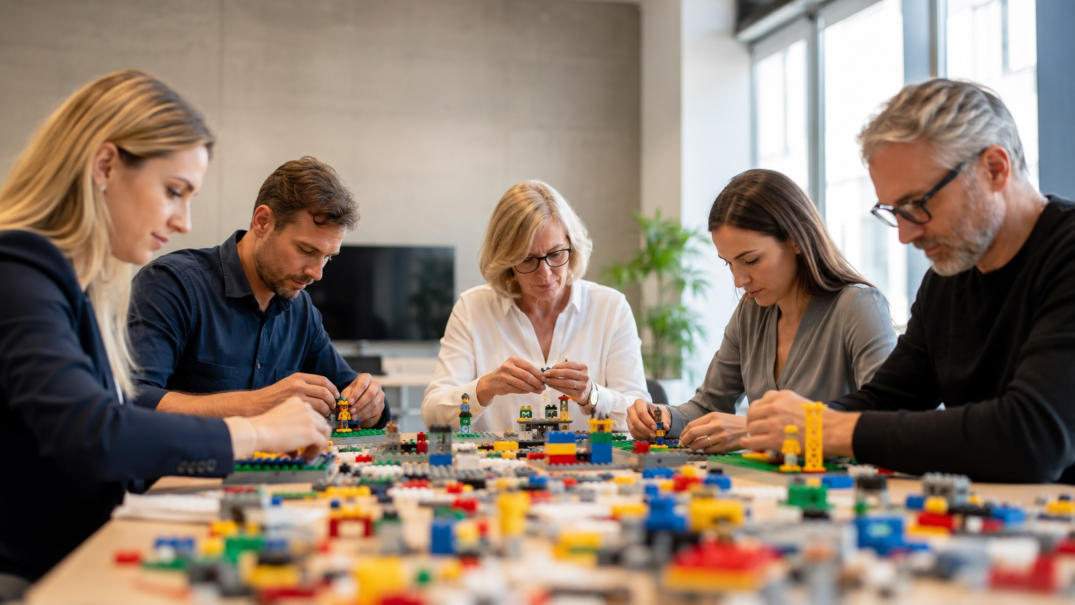
The Core Process of LEGO SERIOUS PLAY, in which participants build their own models instead of merely listening, directly implements Piaget's fundamental idea: Knowledge emerges through active action, not passive transmission.
Someone who sits in a meeting and listens to a new concept for twenty minutes can often barely remember an hour later what it was actually about. Someone who instead builds a model in response to a completely different question can still remember details weeks later that nobody explicitly mentioned. That has to do with how knowledge is created in the first place. Piaget studied this 100 years ago. Long before the age of LEGO. Long before the first interlocking brick was even developed. This principle still supports every LEGO® SERIOUS PLAY® (LSP) workshop today.
What Piaget actually discovered
Against two dominant models of learning
Jean Piaget was a Swiss developmental psychologist, and from the 1920s onwards he observed how children actually think, not how adults imagine they think or how they would like them to think. The incorrect answers he received were of little interest to him in themselves. What interested him was how understanding develops in the first place, a question for which he coined the term genetic epistemology.
In doing so, he deliberately positioned himself against two dominant ideas about learning at the time. The first came from behaviourism: Learning as pure stimulus-response, a brain described through repetition and reinforcement like a blank slate. The second was simpler, the naive transmission model from the classroom: Knowledge is transferred from the teaching person into the head of the learner. Roughly like pouring water from one glass into another.
Knowledge through active construction
Piaget's central thesis contradicted both. For him, knowledge does not arise through absorption. It arises through active construction: People build their own mental models of the world by interacting with it and testing their assumptions. If an assumption does not hold up against experience, they adapt it. Today, this thesis may sound obvious; many people have heard it a thousand times. In the 1920s, it was groundbreaking. His foundational work "The Origins of Intelligence in Children" brought together years of systematic observation of his own children, not a quick idea invented at a desk.
Piaget and Dewey compared
At roughly the same time, the American philosopher John Dewey argued for a related conviction: "learning by doing". For him too, understanding emerges through action, not merely through listening. The difference lies in the approach. Dewey argued pedagogically and philosophically, whereas Piaget argued empirically, based on decades of controlled observation of real children. Because of this foundation, Piaget's constructivism remains influential in developmental psychology to this day.
From schema to assimilation or accommodation: The actual mechanism
Assimilation: When something new simply fits
Piaget called the mental structures with which people organise the world schemas. Every time a new experience is added, one of two things happens.
In the first case, the new information simply fits into an existing schema. It is integrated without the schema itself changing. Piaget called this assimilation. A child who already knows what a LEGO brick is may call another interlocking brick at nursery a LEGO brick even though it is different. No new understanding, it is simply assigned to an existing schema.
Accommodation: When the schema starts to wobble
But what happens when the new information does not fit? Then the schema itself has to change so that the experience has somewhere to go. Piaget called this accommodation. If a child knows a dog and then sees another dog of a different breed, they still recognise it as a dog. If the child then sees a cat for the first time, for example in a picture book, they may also call the cat a dog because it has four legs and fur. Only when this classification no longer works, when enough contradictory first-hand experience is added, for example through repeated contact with real cats and dogs, does a separate schema for "cat" emerge.
Equilibration: The constant movement between the two
Piaget called the constant movement between these two states equilibration. And this is where the point lies for every workshop that aims for genuine understanding rather than mere repetition: Real learning takes place where accommodation becomes necessary, where the old explanation is no longer enough and something new has to emerge. Pure agreement, pure nodding in a meeting, remains assimilation most of the time: Into the head it goes, without much thought. Convenient and fast, certainly, but unfortunately without much real effect. A pity, really.
This equilibration is not a one-off click, not a single aha moment that can be produced at the push of a button. It requires repeated cycles, several rounds in which a schema fails against reality before a new one settles in and becomes stable. One short impulse is usually not enough; several consecutive building and reflection rounds are much more likely to be. Schemas usually survive the first resistance. Only after sufficient repeated confrontation with what does not fit do they actually begin to dissolve. That is why a good LSP workshop rarely relies on only a single building round. A schema genuinely shifts only across several questions and reflection rounds that build on one another, not after the very first round.
Why Piaget experimented with water and glasses
The experiment with the two glasses
Piaget arrived at this theory through systematic experiments. One of his best-known examples: He filled two identical glasses with the same amount of water, had a child confirm that both contained the same amount, and then poured the contents of one of the glasses into a taller, narrower glass. Children under about seven years old then reliably claimed that the narrower glass now contained more water, simply because the water level was higher.
Why explaining did not help
The real key to this experiment is not the incorrect answer itself. What matters is what did not work when trying to correct it. You could explain it to them as often as You wanted: It made almost no difference to the incorrect judgement. Only when the children themselves repeatedly poured, compared and saw their own incorrect judgement fail against reality did their understanding shift. So this has nothing to do with stubbornness or stupidity. It has to be learned through one's own action and the experience of one's own error. (And how often have we burned our own fingers before, and I do not mean only on a hot stove.)
This is the core that Piaget supported empirically over decades and that remains one of the most widely accepted foundations of developmental psychology: Understanding emerges through acting on the world, through resistance, through what does not immediately fit. Not through merely transmitting the correct answer.
Does this also apply to adults in workshops?
At this point, it is worth asking the question that any critical thinker would immediately raise: Piaget observed children, not leaders in change processes. Does this really carry over into a conference room?
The candid answer: Piaget's specific stage theory, describing exactly when a child develops which cognitive ability, genuinely does relate to childhood development and continues to be debated and refined within the field. But the underlying mechanism is something different, and it does not stop at eighteen. The idea that knowledge is actively constructed rather than passively transmitted has long since become a foundation of modern adult education beyond developmental psychology. It ranges from action-oriented and experiential training formats to problem-based learning in universities and companies. Assimilation and accommodation operate in a highly experienced leader during a strategy workshop in much the same way as in a seven-year-old child looking at a glass of water. The schemas are simply more complex, and the resistance to one's own accommodation is significantly stronger because adult schemas have been reinforced over years. And here too, that does not necessarily have anything to do with stubbornness. At least, not usually.
Decades later, Seymour Papert developed the theory further after having worked with Piaget himself: What happens when the purely mental model in the head becomes a shared, tangible object that others can see and discuss? That is constructionism, described in detail in From constructivism to constructionism: Why the model itself is the thinking process.
What this means for the workshop
When talking remains only assimilation
This can be transferred directly to the Core Process used in every LEGO® SERIOUS PLAY® workshop: Question, Build, Share, Reflect. When someone is given a complex question, for example "What is really blocking our team?", they usually already have a schema for it, a ready-made, often premature answer that would simply be thrown out in the next meeting. Purely talking about it remains assimilation in most cases: The existing explanation is confirmed and embellished, but not genuinely changed.
Where accommodation emerges during building
As soon as the same person starts building a model in response to the question, something different happens. The bricks do not behave the way the head imagined. A connection does not hold, a figure does not fit where it was supposed to go, a structure feels more unstable during building than it did in the person's mind. It is precisely at this resistance that the accommodation Piaget described emerges: The existing schema is no longer enough, and a new, often more surprising understanding arises while the hands are still working. This is the basis for a sentence that appears in almost every workshop I run: "Your hands know much more than You think."
For Facilitators, this means that the real task is to deliberately create the conditions for accommodation in every building phase, not merely for pleasant confirmation. That is the difference between a workshop that feels good because everyone agreed and one that actually changes something because someone knows something different at the end than they did before.
What remains
Constructivism therefore does not merely provide a nice additional justification for LEGO SERIOUS PLAY. It explains why talking alone in meetings so often has no lasting consequence, while built models can change something that is still present weeks later. What begins with the individual mental model in the head is still only half the story. The other half, the shared object on the table that others can see and think with, is told in From constructivism to constructionism: Why the model itself is the thinking process. An overview of all the schools of thought behind the method can be found in The science behind LEGO® SERIOUS PLAY®.
Anyone who does not yet know the method can start with LEGO SERIOUS PLAY explained briefly. The best way to experience what it feels like live is at the free Meetup: Dates for the next training programmes.
By Matthias Renner, AI-assisted research.
0 Comments