

A few quick answers up front:
Is LEGO SERIOUS PLAY scientifically grounded, or is it just another super-creative training method?
The method draws on several independent research traditions that are decades old: constructivism, constructionism, neuroscience/Embodied Cognition, Flow Theory and play theory/Playful Learning. Each of these is widely recognised outside LEGO SERIOUS PLAY as well and has been researched for decades within its own academic field.
Why is there an entire article series just about the science behind it?
Because a brief mention in the introductory article LEGO® SERIOUS PLAY® explained briefly does not do justice to the depth of the individual theories. This series gives each school of thought its own detailed article instead of dealing with it in a single sentence.
Which six topics does this first article series cover?
Constructivism according to Piaget, constructionism according to Papert, Embodied Cognition and neuroscience, Flow Theory according to Csíkszentmihályi, play theory/Playful Learning and the origin story of Robert Rasmussen and Per Kristiansen.
Are critical perspectives on the theories cited also included?
Yes, of course. These articles are not intended to be a celebration without criticism.
In what order should I read the six articles?
Piaget and Papert require the least prior knowledge and build directly on one another. The other four can be read independently in any order.
Is it enough to read only this article, or do I need to go through all six individual articles?
This article provides the overview and the connection between the six theories. Anyone who wants to go deeper into a particular theory, for example because that is the one most relevant to their own scepticism, will find the full reasoning, original sources and practical application to LEGO SERIOUS PLAY in each linked individual article.
"Adults playing with LEGO bricks." Yes. Well, not quite. I already used that sentence in the article LEGO® SERIOUS PLAY® explained briefly. At the end, there was an open promise: "Exactly how much lies behind constructivism, constructionism and Flow Theory could fill an article of its own." So here it is, or rather, the beginning of it. Because while writing, the whole thing escalated.
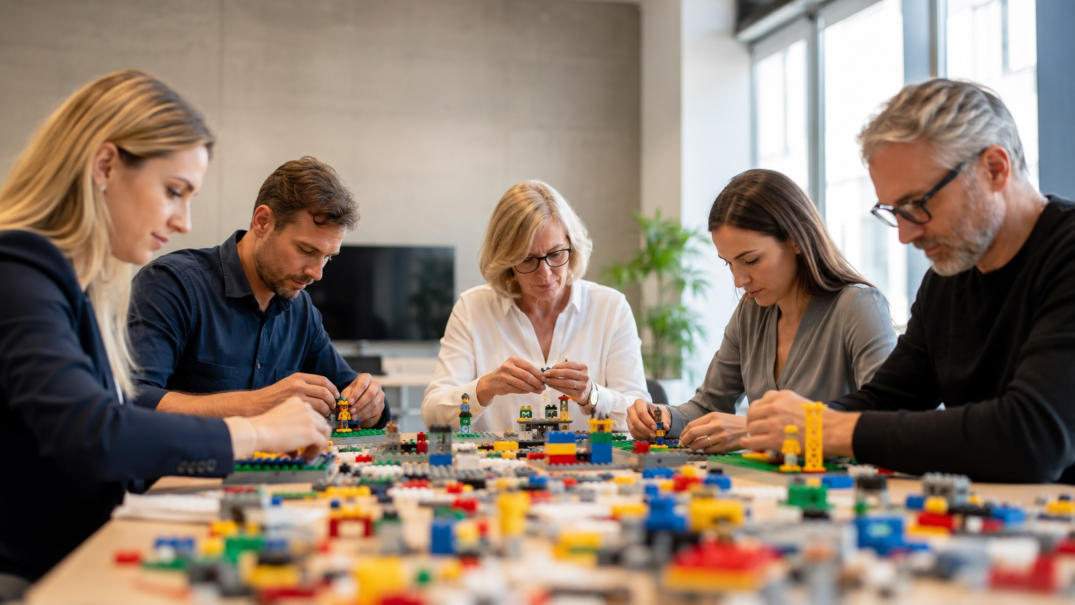
When someone hears about the method for the first time, they never hear about the research. They only hear LEGO and Play; the "Serious" gets completely lost. The first impression is then colourful LEGO bricks on a table and adults building instead of talking.
But if someone invests a four-figure amount in training, "adults building with LEGO" may be a little thin as an outcome. So the question cannot be "Are they having fun doing it?" It should rather be: "Does this actually have substance?" "Is it well founded?" Those who know me also know my answer: "Yes, of course."
But I want to take a little more time here and answer in detail. Admittedly, this article is a little longer, but even then it is not the whole story. It briefly covers constructivism, constructionism, Embodied Cognition, Flow Theory, play theory and the origin story of the method, and links again to individual articles that connect the scientific theories with what happens in a workshop. This first article series covers the learning foundation: Why building with Your hands achieves more than listening and talking.
But first things first.
The starting point: Knowledge emerges through action, not through listening
We begin with a Swiss developmental psychologist who, from the 1920s onwards, spent decades observing how children actually think, not how adults imagine they think or would like them to think. Jean Piaget deliberately positioned himself against two dominant ideas of learning at the time: behaviourism, which described learning as pure stimulus-response reinforcement, and the naive transmission model from the classroom, where knowledge is poured from the teaching person into the head of the learner, roughly like pouring water from one glass into another.
Piaget's central thesis contradicted both. Knowledge does not emerge through absorption. It emerges through active construction: A person builds their own mental models of the world by interacting with it and testing their assumptions. If an assumption does not hold up against experience, they adapt it. Piaget coined the term genetic epistemology for this research approach, and his foundational work brought together years of systematic observation, not a quick idea invented at a desk. That is constructivism. It forms the foundation of every LEGO SERIOUS PLAY workshop: A model is not created to illustrate an already finished opinion. It emerges while the person building it is still discovering their own perspective.
Piaget's stage theory itself relates to childhood development, but the underlying mechanism is widely recognised in adult education and organisational development. Exactly how this mechanism works and why it also applies to leaders in a conference room rather than only children in a sandbox is explained in detail in Why we learn through action: Constructivism according to Piaget.
From the mind to a shared object: Why the model itself is the thinking process
Piaget described how an individual builds knowledge in their own mind. The mathematician and learning researcher Seymour Papert, who worked directly with Piaget in Geneva for five years before moving to the MIT Media Lab, added one crucial point: Learning is particularly powerful when it produces a shared, tangible object, a sandcastle, a programmed turtle, a LEGO SERIOUS PLAY model. Papert called these "Objects to Think With", objects for thinking. Thinking happens through the object itself, not only in the mind in front of it, and it becomes visible and discussable for others once it exists.
Papert arrived at this idea through a very personal route: a childhood fascination with gears that began before he even understood how a gearbox worked. Years later, while reading Piaget's work, he recognised in this memory what Piaget called "assimilation", fitting new experiences into existing patterns of thought. Piaget described assimilation almost exclusively as a cognitive process. For Papert, part of the story was missing: The gear was not merely an object of thought for him, it was something he could touch, turn and share with others. From this gap grew one of the most influential learning theories of the 20th century, constructionism, set out in the 1980 book "Mindstorms: Children, Computers, and Powerful Ideas".
For a workshop with several participants, this is the decisive difference from Piaget's original idea: A model on the table is not only one person's private thinking process. Once it exists, it becomes a shared basis for negotiation for the whole group. The full origin of this idea is described in From constructivism to constructionism: Why the model itself is the thinking process.
The neural foundation: What Embodied Cognition knows about hands and thinking
Piaget and Papert describe why active action and shared objects change learning. What neither of them explains is the neural level underneath. This is where Embodied Cognition comes in: the field of research showing that thinking does not happen exclusively in the head but is also shaped by movement, posture and sensory perception. Closely related is the broader Grounded Cognition research associated with Lawrence Barsalou, which assumes that concepts are processed partly through simulations of action and perception, not only through abstract symbols in the mind.
One particularly striking finding comes from a 1998 study by Jana Iverson and Susan Goldin-Meadow: People who have been blind from birth gesture while speaking, even when the person they are speaking to is also blind and will never see the movement. So the hands do not move primarily for an audience. They are involved in thinking itself. In English, a phrase sums this up neatly, one that occasionally appears in a LEGO SERIOUS PLAY workshop: "Give your brain a hand."
What this line of research shows about working memory, gesture and the limits of talking alone, and why that matters for workshops with adults rather than only children at play, is explained in Hands and mind: What Embodied Cognition knows about thinking with Your hands.
The right level of difficulty: Why workshops create Flow
People voluntarily hang from a rock face without prize money and without an audience even noticing their success. This observation led Hungarian-American psychologist Mihály Csíkszentmihályi in the 1970s to systematically investigate the conditions under which people become completely absorbed in an activity, focused, without a sense of time and without self-doubt. His first major work on the subject, "Beyond Boredom and Anxiety" (1975), described interviews with climbers, chess players, dancers and surgeons, a deliberately odd focus group. Only with his second book, "Flow: The Psychology of Optimal Experience" (1990), and a methodological innovation, the Experience Sampling Method, in which participants were randomly asked about their current state over the course of several days, did the term become established beyond academia.
His answer: Flow emerges in a narrow corridor between boredom and overwhelm, where a task lies just above the person's current ability. For a LEGO SERIOUS PLAY workshop, this is an important observation. The deliberately short building time set by Facilitators creates this time pressure: Enough to prevent perfectionism and endless deliberation, not so much that the task becomes paralysing. An important limitation remains: Flow is an empirically described psychological state, not a switch that workshop design reliably turns on in every individual person. It merely increases the likelihood significantly.
How this balance is designed in practice and what Flow actually promises, and what it does not, is explained in The right amount of resistance: Why LEGO® SERIOUS PLAY® workshops create Flow.
The framework that allows ideas: Serious play is not a contradiction
Just before someone reaches for the bricks for the first time in a workshop, almost the same thing always happens: A brief hesitation, a glance to the side to see whether colleagues have already started, sometimes a small apologetic laugh. The question behind it: Am I allowed to take this seriously even though it looks like play? Cultural and social-science theories of play, shaped by Dutch historian Johan Huizinga and his 1938 work "Homo Ludens", provide an answer. This is not to be confused with the mathematical game theory of John von Neumann and John Nash, which deals with negotiations and conflict models. Here, the focus is on play as an independent form of human behaviour, examined by authors such as Huizinga, Mainemelis, Henricks and Sicart.
Huizinga's central observation, in his own words: "Within the play-ground an absolute and peculiar order reigns", an order that has no meaning outside that space. Later play theorists add to and differentiate this: Henricks emphasises that play contains both order and disorder at the same time, while Sicart describes how play extends beyond its own space into the real world. For workshop practice, the crucial point is that a threshold exists at all, visibly and tangibly separating the play space. This reduces fear of evaluation and increases people's willingness to express unusual ideas openly without having to fear being permanently pinned down to a single statement.
Why a fixed set of rules does not contradict this freedom but actually makes it possible is explained in Serious play is not a contradiction: What play theory shows about creativity.
Not invented at a drawing board: The story of Rasmussen and Kristiansen
Five schools of thought explain why the method works. The sixth explains why it is not a sudden invention that someone recently cobbled together. The idea of using LEGO bricks for strategy work came from Johan Roos and Bart Victor in the mid-1990s. It only became a robust, repeatable method when Danish educator Robert Rasmussen took over systematic development from 1999 onwards; strategist Per Kristiansen joined at the end of 2001. Both presented the completed method to the public in 2001, and together they founded the Association of Master Trainers in 2010.
This timeline is already described in LEGO® SERIOUS PLAY® explained briefly. What is missing there is the question of who these two men were professionally before they developed the method. Rasmussen holds a Master's degree in Education from the Royal Danish School of Education, along with studies in psychology and sociology, and spent a total of thirteen years at LEGO as Head of Research and Development for LEGO Education, where he was also responsible for LEGO Mindstorms, the product whose name, fittingly enough, comes from Papert's book. Kristiansen holds a Master's degree in International Business from Copenhagen Business School, complemented by examinations at Università Bocconi in Milan, and later headed the global business for the method at LEGO.
This combination of educational and strategic thinking helps explain why the method still holds up in its original depth today instead of disappearing as a short-lived trend. The full professional backgrounds of both men are described in Not invented at a drawing board: The story of Rasmussen and Kristiansen.
What these six schools of thought support together
Six independent lines of research
None of these six theories was invented for LEGO SERIOUS PLAY. Piaget observed children, not leaders. Csíkszentmihályi was not thinking about participants in conference rooms, but interviewed climbers and surgeons. Huizinga wrote in 1938 about play as a cultural phenomenon, long before anyone thought of using it to design strategy workshops. And, quite frankly, when six independent lines of research that originally had nothing to do with one another all end up pointing in the same direction, that is a significantly stronger argument than any single study developed specifically for the method could ever be.
The theory came first
A critical objection is nevertheless obvious: Could any training method not be justified afterwards with suitable theory if one searches the research literature long enough? The difference here lies in the sequence. Rasmussen and Kristiansen did not first develop the method and then look for a justification. Piaget, Papert, Csíkszentmihályi and Huizinga published their work decades before the first LEGO SERIOUS PLAY session, in some cases before the developers of the method had even been born. The theory came first, the application followed.
Independently verifiable, not merely asserted
A second obvious objection: Five of the six names in this article, with the exception of Rasmussen and Kristiansen themselves, were neither inventors nor advisers to the method. Piaget and Huizinga died before LEGO SERIOUS PLAY even existed; they could not possibly have heard of it. Papert and Csíkszentmihályi were different in that respect. None of the four ran LEGO SERIOUS PLAY workshops. Their work can be read, cited and verified independently, in academic journals that have nothing to do with training providers. Anyone questioning the theories themselves is questioning established foundational research, not a marketing promise from Matthias Renner or the Association of Master Trainers.
The chain of the six articles
Together, the six articles form a chain that can be read step by step: Knowledge emerges through active action, not through listening (Piaget). It emerges especially effectively when a shared, tangible object is created in the process (Papert). This action with the hands is neurally involved in thinking itself, not merely a practice opportunity afterwards (Embodied Cognition). For this to work, the right level of difficulty is needed, neither boredom nor overwhelm (Flow). A bounded framework is needed that reduces fear of one's own perhaps unusual idea (play theory). And the story of Rasmussen and Kristiansen shows that this chain does not only work on paper but has been tested in real workshops for more than two decades. (Putting my own experience alongside that would feel rather presumptuous.)
What comes next
Two more series will follow, not all topics at once, so that everything can be completed properly.
The second article series focuses on knowledge and meaning in dialogue:
- Vygotsky's social learning
- Polanyi's tacit knowledge
- Boundary Objects as translators between professional worlds
- Lakoff's metaphor theory
The third series focuses on process and group dynamics:
- Psychological Safety according to Amy Edmondson
- Kolb's Experiential Learning Cycle
- Divergent and convergent thinking according to Guilford
- Status reduction in groups
- Cognitive Load and Dual Coding research on building and storytelling
As soon as these articles are complete, this overview will grow accordingly, including new links between the individual series.
Whether this convinces You in the end or not is Your decision. But what these six articles no longer allow You to do is use the convenient excuse that there is nothing behind the method except colourful LEGO bricks and an entertaining afternoon. If You want to experience for Yourself what this research becomes in a workshop, You can find the next dates at matthias-renner-trainer.com.
By Matthias Renner, AI-assisted research.


0 Comments