
A few quick answers up front:
Why is a LEGO SERIOUS PLAY workshop more expensive than a normal meeting?
Because it is not comparable to a normal meeting. It replaces several meetings that would otherwise become necessary because of renegotiation and overlooked objections, and it secures results that might otherwise end up in a drawer.
What do companies actually buy when they book LEGO SERIOUS PLAY?
Not bricks. Depending on the situation, they buy a robust solution, less renegotiation in everyday work, or an experience that traditional workshop formats do not provide.
Is a LEGO SERIOUS PLAY Facilitator training financially worthwhile?
Only if it is clear which of the three reasons Your own clients are looking for and the workshop is designed accordingly. Pure technical mastery alone does not support a business model.
Is LEGO SERIOUS PLAY only suitable for creative teams?
No. Initial scepticism appears in technical and creative teams alike, and disappears in both cases once people have their own bricks in front of them.
"The bricks make it feel relaxed, the method is fun." True. But that does not explain why someone invests 36 hours in training or why a company approves a daily budget that is significantly higher than for a traditional meeting.
People fundamentally spend money for only three reasons: For a solution, for more convenience or for an experience they cannot get anywhere else. This is not some marketing model invented at a drawing board, but an observation that can be applied to almost any purchase, whether someone calls a tradesperson, orders food delivery or buys a concert ticket.
That leads to a question for anyone who sells something, a question that is rarely asked. It is not "Am I selling a good product?" The real question is: Which of these three reasons am I actually serving, and am I convincing at it? Most providers, myself included, rarely answer this question clearly. Instead, they advertise with everything that sounds vaguely positive: Innovative, sustainable, effective. Cheap words that cost nothing and ultimately explain nothing.
So I asked myself the question: "Why do people really buy LEGO SERIOUS PLAY?" After more than ten years of practical experience, my answer is: this trio, just rarely described in those terms.
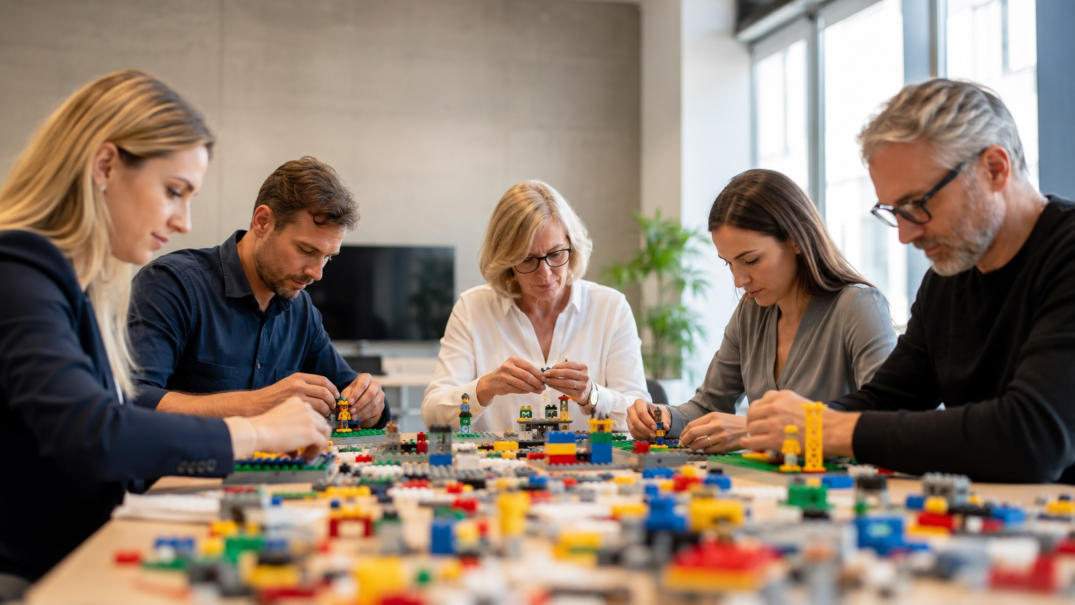
A quick explanation in case the method is new to You: LEGO SERIOUS PLAY (LSP) is a facilitated method in which participants use LEGO bricks to build models representing their answer to a question, for example about team collaboration, strategy or a specific project problem. How the Core Process behind it works in detail is explained in LEGO® SERIOUS PLAY® explained briefly. This blog post is about something else: not how the method works, but why people invest time and money in it.
The solution
When results end up in a drawer
Many workshop results still end up in a drawer. Flipcharts are photographed, Post-its are collected, and three weeks later nobody remembers what was actually decided. The insights disappear into day-to-day business before they ever have a chance to make an impact.
A familiar picture: A strategy workshop ends with an impressive wall full of colourful cards. Everyone nods with satisfaction, someone takes a photo, and the whiteboard is wiped clean. Six weeks later, someone desperately searches through their phone for the photo because someone asks in the next meeting: "What did we actually decide back then?"
What actually sticks after the workshop
What emerges in an LSP workshop is secured differently. The models that were built remain as reference points, and the participants told the stories behind them themselves, meaning they understood them rather than merely documenting them. Anyone who has built a model themselves can still remember the reasoning behind it weeks later, because the knowledge does not sit only in the head, but also in the hands.
That is why follow-up after an LSP workshop feels different from traditional formats. It is not about reconstructing afterwards what people may have meant. It is about documenting something that everyone in the room has already understood together. The real difference is not whether a workshop was good. It is whether something remains afterwards that people can actually continue working with in everyday life.
The convenience
At first, that sounds wrong. An LSP workshop is more demanding than a meeting with a flipchart, that is true. The real convenience only becomes visible afterwards.
Why decisions have to be made several times
A strategy meeting like the ones that happen somewhere every week: One person presents their proposal, three others nod politely. They are not fully present anyway. In their heads, objections are already forming that nobody expresses openly. Two weeks later, in a completely different context, the same objection appears again, sometimes as open criticism, sometimes as silent resistance. The decision is therefore not made once. It is made three or four times, each time requiring the same amount of energy.
Anyone who has worked in an organisation probably knows this dynamic: The hierarchy sits around the table, the highest-ranking person speaks first, and everyone else carefully adjusts to that position. Anyone with a different opinion thinks very carefully about whether raising it is worth the effort. Usually the answer is: Better not, not now, maybe later in a private conversation.
No more renegotiation
In an LSP workshop, nobody holds back their opinion because every person builds and explains their own model before anything is reflected on or decided together. Taboos that would otherwise remain unspoken come openly onto the table. There is no renegotiation afterwards. Nobody says two weeks later: If only someone had asked me, I was not heard. Or: That was never going to work anyway. Every person gets a voice during the workshop itself, is heard and understood, not only afterwards. These are exactly the sentences that make traditional change processes so slow, because they lead to endless coordination rounds in which decisions that were already made are reopened. If You were part of building it from the beginning, You are much more likely to stand behind it in the end. That saves time, even if the individual workshop takes longer than expected.
The experience
Almost everyone secretly thinks: Seriously? I am supposed to work on a complex business challenge with building bricks?
Usually one person in the room shows this scepticism most clearly: arms crossed, a quick glance at the person next to them, a quiet "Let's see how long this takes." And that person is often the first one to become deeply absorbed in their own model after the first few minutes, because the hands start building something the head has not yet fully understood.
The scepticism remains justified until the person's own bricks are in front of them and the real problem begins to take shape. At that moment, the doubt disappears. What was previously abstract, a vague concern, a diffuse gut feeling, suddenly takes on a form that can be touched and moved. No PowerPoint slide creates that feeling. That is why people who have worked with the method once are more likely to use it again for the next important question instead of returning to a traditional meeting. They have experienced what it feels like when their own thinking becomes visible, and that is not easily forgotten.
Solution, convenience, experience
That is what people actually buy when they learn or book LEGO SERIOUS PLAY. Not "fun with colourful LEGO bricks in bright colours."
For me as a trainer, this insight has a practical consequence. When I train Facilitators, it is not only about the technique of the method. It is also about understanding which of these three reasons a client or team currently needs most urgently, and designing the workshop accordingly. Anyone who does not distinguish between them may still build a technically sound workshop at best. But they may completely miss the client's actual need.
For anyone who works with methods or training, the same question from the beginning applies. So once again: Which of these three reasons am I really serving, and am I convincing at it?
That is also at the heart of what I teach in the four-day Facilitator Training. Not only how the Core Process, Application Techniques and Skills Building of LEGO SERIOUS PLAY work, but how You as a Facilitator recognise what a room really needs at that moment and how You design Your workshops accordingly.
"No buzzwords, but skills that last." Anyone who only masters the technique has skipped part of the training. Whether this distinction is enough for You or not is Your decision. In any case, I am not selling bricks here.
If You would rather read about this from a corporate perspective, Brickolution® covers the method in detail from the perspective of companies.
If You want to learn the whole thing Yourself: You can find dates for the next training programmes at matthias-renner-trainer.com.
By Matthias Renner, AI-assisted research.


0 Comments