

A few quick answers up front:
What exactly is Skills Building in LEGO SERIOUS PLAY (LSP)?
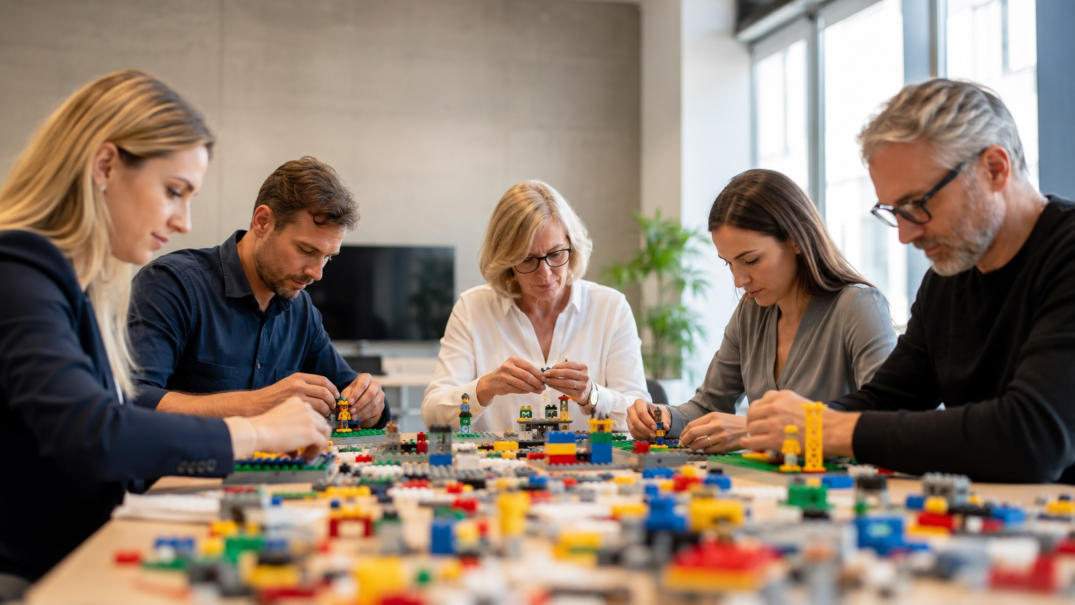
Skills Building is the first phase of an LSP workshop, in which participants get to know the method, its rules and how to build with the bricks before the actual content work begins. It usually takes around one hour and consists of four rounds that build on one another.
Is Skills Building the same as an icebreaker or warm-up?
No. An icebreaker loosens up a group, nothing more. Skills Building develops actual competencies: the building language of the method, the workshop conventions and an initial level of trust in the person leading it. It is part of the workshop, not a loose prelude before it.
Can Skills Building be skipped to save time?
No, unless a group has already worked with the method before. In that case, it can be omitted or shortened considerably. With a new group, that hour is considered firmly reserved.
Why is there one round in Skills Building where participants build from instructions, even though that never happens in the rest of the workshop?
Because it helps participants get to know the bricks and experience a quick sense of success, not because of the content work. Anyone who has not built with the bricks for a long time gains confidence in handling the material within just a few minutes, before creating their first metaphor.
"Ah, then why don't we just skip the Skills Building at the beginning?!"
No. No. No.
This question comes up more often than you might think, usually from someone who wants to save an hour of workshop time. The answer is always the same: This first hour of a LEGO SERIOUS PLAY workshop is firmly reserved. It is never shortened, no matter how tight the schedule is. Skills Building is non-negotiable, and probably even the most important part of the entire workshop.
By saving this one hour at the beginning, you ruin the rest of the workshop. But hey, at least you saved an hour.
Sounds strange, but that's how it is. But first things first: What exactly is Skills Building if it isn't an icebreaker?
Not an icebreaker. A foundation.
An icebreaker is supposed to loosen up a group, nothing more. Skills Building teaches something much more concrete: the building language of the method, which is later used to create every metaphor. Participants may experience for the first time how a pile of bricks turns into a story, referred to as Storymaking in the terminology of the method. They learn the rules of the workshop, for example that every model stands on its own and nobody contradicts it. And they gradually build trust, both in the method itself and in the person guiding them through the day.
This trust is also connected to psychological safety, a concept developed by researcher Amy Edmondson. People only truly contribute when they can be sure that nobody will ridicule their first, perhaps tentative answer. This sense of safety is not created by making an announcement at the beginning. It develops round by round.
The four rounds that make up Skills Building
- Free building with a small set. A few bricks, a simple first task, and off you go. Anyone who hasn't played with the bricks for decades gets back into it without any expectation of producing a perfect result. By the way, it is always the same task, nothing particularly fancy, but enormously effective. And even after more than ten years, I still use exactly the same task.
- Building according to instructions. This may sound paradoxical because during the rest of the workshop, participants never build according to instructions. This round still serves an important purpose: Participants get to know the bricks, which ones are transparent, which ones move, how they fit together, and at the same time they experience a quick sense of success. That feeling of "I can do this" creates confidence for the rest of the day.
- Turning the instruction model into a metaphor. The model that has just been built is reinterpreted; it becomes an image for something else. For many participants, this is the first moment when they truly understand how metaphors work. They experience it before they have to do it themselves for the first time with their own topic.
- Storymaking. In this fourth round, the focus is on Storymaking, not on getting closer to the objective of the day.
If you like comparing this sequence to an image: Skills Building is the training before the marathon, not the race itself. It is not about already reaching the finish line. It is about making sure that all participants are standing on the same starting line before the actual race begins. If you skip this hour, you send someone who has never run before into a race against someone who has already completed ten marathons. And on top of that, not everyone would even start from the same line: Some would get a 5 km head start, while others would feel as though they had to run an extra 10 km.
Why this hour determines the entire day
Three things happen during this one hour, never just the building itself:
- Participants acquire the skills they need to work with the method in the first place, without which nobody can seriously build their own metaphor.
- They learn the conventions and rules that support the entire day, from the first to the final building round.
- And they build trust in the Facilitator who guides them through the workshop. In addition, they experience psychological safety, a prerequisite for getting honest answers later, even to uncomfortable questions.
Anyone who removes this hour is cutting away at the foundation on which the entire rest of the day is built. A short LEGO SERIOUS PLAY training is perfectly sufficient is about exactly this kind of shortcut. It shows what gets lost when a short-format training reduces everything to what appears to be absolutely necessary. Skills Building is usually one of the first things to disappear because, at first glance, it seems like the easiest hour to do without.
Anyone booking an LSP workshop rarely has the opportunity to assess this first hour in advance. There is still a simple indicator: A Facilitator who openly explains how this hour works and why it is non-negotiable has probably internalised it themselves. Someone who only mentions it briefly or presents it as optional usually hasn't understood it themselves either.
If You want to become a Facilitator Yourself
For aspiring Facilitators, this is more than just a side note. A training programme that thoroughly teaches the Core Process, the seven Application Techniques and Skills Building provides much more than mere knowledge of the method. I have already discussed this in What You really sell as a Facilitator. Anyone who only knows the outward sequence but has never learned why this first hour carries so much weight will later deliver, at best, a pleasant afternoon with colourful photos. In that case, You might as well spend the afternoon having coffee and cake; under certain circumstances, You may get more out of it.
You can find a detailed explanation of what the method as a whole can achieve beyond this one hour at brickolution.com.
Skills Building is not a warm-up exercise. It is the foundation of every successful workshop. And it is the reason why, at the end of the day, everyone reaches the same destination, not just those who already had experience. If You want to experience what this feels like live: You can find dates for the next Meetups and training programmes at matthias-renner-trainer.com.
By Matthias Renner, AI-assisted research.

0 Comments