

A few quick answers up front:
What does the term "Embodied Cognition" mean?
Translated literally: embodied cognition. This field of research examines how thinking does not take place exclusively in the head. Movement, posture and sensory perception also shape it. The central thesis: Concepts and thoughts are processed partly through simulations of action and perception, not only through abstract symbols.
Is the connection between hand movement and thinking actually scientifically proven?
Yes, across several independent lines of research. The effect of gesture on speaking and learning is particularly well established, researched among others by Susan Goldin-Meadow at the University of Chicago. This is complemented by the broader Grounded Cognition research associated with Lawrence Barsalou. Both are established research fields that have been repeatedly studied for decades.
Does building with Your hands automatically make You smarter?
No, not in general. Research shows that action can support thinking processes and reduce the load on working memory, not that every individual hand movement automatically leads to better results. What matters is how meaningfully the action is connected to the question, not the action alone.
Why do people build with their hands in LEGO® SERIOUS PLAY® instead of only discussing?
Because building makes knowledge accessible that would often remain unspoken in pure conversation. The hands work through ambiguity before the right words are available. This helps explain the frequent effect: "I didn't know that I knew that."
Isn't that simply "Learning by Doing"?
Not quite. Learning by Doing emphasises that practical action helps learning, regardless of why. Embodied Cognition explains the mechanism behind it more precisely: Movement is not merely an opportunity to practise, but is actually involved in the thinking process itself at the neural level.
People who have been blind from birth gesture while speaking. Even when the person they are speaking to is also blind and will never see the movement. This finding comes from a 1998 study by Jana Iverson and Susan Goldin-Meadow, published in Nature, and has been well documented ever since. It raises an uncomfortable question: Why move Your hands if nobody is watching?
The obvious answer, that gesture clarifies communication for the other person, clearly does not go far enough here. The real explanation is far more interesting: The hands do not move primarily for an audience. They move because they are involved in thinking itself.
This is where research on Embodied Cognition begins. For a LEGO SERIOUS PLAY workshop, in which adults spend hours working with their hands on a model instead of merely discussing around a conference table, this is fundamental: the neuroscientific basis for why this way of working can achieve something that talking alone cannot. Anyone who has ever built like this instead of only talking has probably felt the effect, even without knowing the name for it.
Thinking is not purely a matter of the head
The classic idea of thinking
How do most people imagine thinking?
- The body provides sensory impressions.
- The brain processes them into abstract symbols.
- The actual thinking then happens separately from the body, like in a computing unit.
In this picture, the body is merely a supplier, not part of the thinking process itself. It sounds logical and reasonably understandable. But by now we know that this is not how it works. That would be too simplistic and far, far too easy.
Barsalou's Grounded Cognition
Grounded Cognition research has been strongly shaped by cognitive scientist Lawrence Barsalou. Its central thesis: When people understand or retrieve a concept, they activate at least partly the same sensory and motor areas that would also be active during actual perception or action. So the phrase "grasping an idea" does not use a grasping metaphor by coincidence. It involves motor simulation processes.
Concrete and abstract concepts
For concrete concepts such as cup or staircase, this is now well established. When someone thinks of a cup, measurable activity appears in areas that would also be active when actually grasping a cup, including the grasping movement of the hand. With "staircase", the corresponding areas are those that would otherwise become active when climbing or stepping. The brain simulates the action along with the word, even when only the word is present.
Things become more difficult with abstract concepts such as justice or strategy, for which there is no direct sensory equivalent. Barsalou's answer: Abstract concepts instead draw on internal states, on introspection, emotion and the experience of recognising something as coherent or incoherent. With the concept of strategy, for example, it may be the feeling of control or orientation that arises when a plan works out, not an image of action or movement. No longer eye and hand, but still the body as a resource, just on a different level.
What imaging studies show
Imaging studies provide a concrete indication of this. When someone reads a word such as "kick" or "grasp", measurable activity appears in exactly those areas of the motor cortex that would also be active during the actual leg or hand movement. This effect has been replicated several times since the mid-2000s. Language about action is therefore not a purely symbolic matter. It draws at least partly on the same motor circuitry that would also control the action itself.
Cognitive science still debates the extent to which bodily processes are involved in thinking. The strong version, that thinking is constitutively made up of bodily processes, is considered vulnerable to criticism among experts. That bodily processes causally influence and support thinking without fully replacing it, however, is considered well established. For the question of why building helps thinking, this weaker but well-supported version is entirely sufficient; there is no need for a stronger claim.
The hands think along before the words are there
First: Gestures reveal knowledge before words do
The research becomes most concrete when it comes to gesture, the specialist field of Susan Goldin-Meadow and her team at the University of Chicago. Their findings can be summarised in three core results, each replicated many times.
Gestures reveal knowledge before it can be expressed in words. The original observation came from experiments with classic Piaget tasks on conservation. A standard example: A child of around five to seven years sees two identical glasses containing the same amount of water. In front of the child, the contents of one glass are then poured into a narrower, taller glass. Children of this age often say that there is now more water because the level is higher, a typical incorrect answer. But while explaining their answer, their hands often simultaneously indicate the narrower width of the new glass. This is a sign that they are already noticing the crucial second factor, the width, even though it is still missing from the spoken answer. These so-called gesture-speech mismatches are now considered a reliable signal that someone is close to understanding a concept, even before that understanding appears in language.
Second: Gesture reduces the load on working memory
Someone who uses their hands while explaining a calculation demonstrably has more mental capacity left for the actual thinking task. One example: If someone adds 27 and 15 in their head and uses a hand movement to indicate which tens digit is currently being carried over, that intermediate calculation no longer has to be held entirely in the mind. Part of the representation moves outward into the movement instead of having to be held completely in the head. The hand literally takes over part of the calculation.
Third: What is learned with gesture lasts longer
What is learned with gesture stays accessible for longer. In a 2008 study by Susan Wagner Cook, Zachary Mitchell and Susan Goldin-Meadow, published in Cognition, children used their own gestures or were instructed to gesture while learning a new calculation strategy. They were able to retrieve what they had learned more reliably over a period of weeks than children who had only heard the same explanation. All three findings have been replicated many times in different places over decades, which is by no means something to take for granted in psychology.
Taken together, these three findings paint a clear picture: Hand movement is not merely an accessory to thinking that illustrates afterwards what has already been completed in the head. It is part of the process through which a thought takes on its final form in the first place.
What that means for a table full of colourful bricks
When talking is not enough
Most meetings work the other way around. People talk until everyone feels that enough has been said, often happily repeating the same things several times. What gets written down at the end is usually still only what was already in the room beforehand.
In the article "LEGO® SERIOUS PLAY® explained briefly", there is a sentence many participants say in one form or another after their first workshop: "I didn't know that I knew that." In English, there is a fitting phrase for exactly this effect: "give your brain a hand". After everything described above about gesture and Grounded Cognition, this can now be explained more precisely instead of leaving it as just a nice phrase.
What becomes visible while building
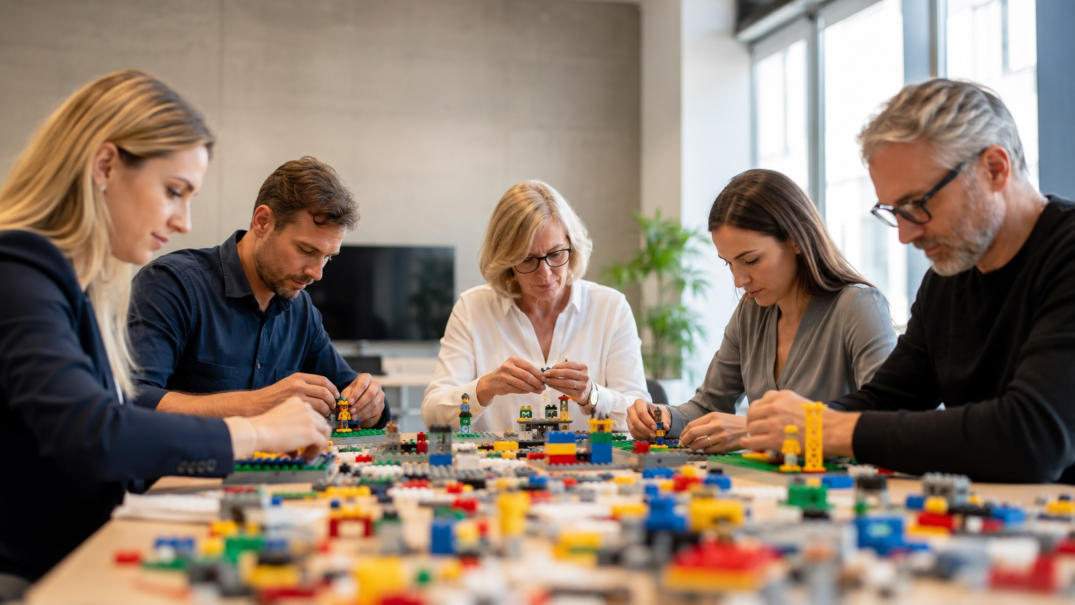
When someone builds a model in response to a complex question, for example about their own role in a team, something similar happens to what happens with the children in the gesture-speech mismatch, only in more detail and with a tangible result at the end. The hands work through a structure, connections, distances, what stands next to what, before the right words are even available. The finished model makes visible what would have remained vague in pure thought or conversation. This aligns with Seymour Papert's constructionism: Not only does action drive thinking forward, but so does the emerging, shared object itself.
Manipulatives in education
A second line of research, also well studied for decades, confirms the same picture: the use of manipulatives, objects that are touched and moved, in education. The same effect appears in mathematics education. Handling concrete objects reduces the cognitive load involved in abstract content. Part of the thinking work moves into the action and into the object itself instead of having to be processed entirely in the head. For a strategy discussion that is already complex enough, this relief is particularly valuable. Anyone who does not have to juggle the entire complexity in their head has more capacity left for the actual content.
A shared object on the table
On Brickolution®, my platform for corporate clients, I often describe it like this: Afterwards, a model is visibly standing on the table for everyone. Beforehand, several people in the same conversation may have had completely different images in their heads without realising it. Afterwards, everyone is looking at the same object. The research above provides the neuroscientific explanation for this. A built model is not a nice addition to the discussion. It is the mechanism through which knowledge becomes accessible in the first place that would otherwise have remained unspoken. Good facilitation does not make this unnecessary, fortunately! But it does make it a little easier.
Conclusion
The hands are not a tool that merely carries out what the head has already finished thinking. They are involved in the process that turns a thought into a finished thought in the first place. Research on gesture and Grounded Cognition show this independently and consistently. For a workshop in which people build instead of only talking, this explains why there is often more on the table at the end than anyone could have put into words beforehand. And often much more is literally under-stood and grasped as well.
The complete overview "The science behind LEGO® SERIOUS PLAY®" brings together all the other schools of thought that help explain the method.
Anyone who wants to experience what this feels like instead of only reading about it can find a first, no-obligation introduction at the next dates.
By Matthias Renner, AI-assisted research.
0 Comments