
A few quick answers up front:
What is an example of a LEGO SERIOUS PLAY case study in change management?
The Adult Pastoral Care Department of the Archdiocesan Pastoral Office in Freiburg ran a workshop in the middle of the major "Church Development 2030" project to clarify its own role and distribution of responsibilities before the surrounding structure changes fundamentally.
How did the LEGO SERIOUS PLAY workshop described here work?
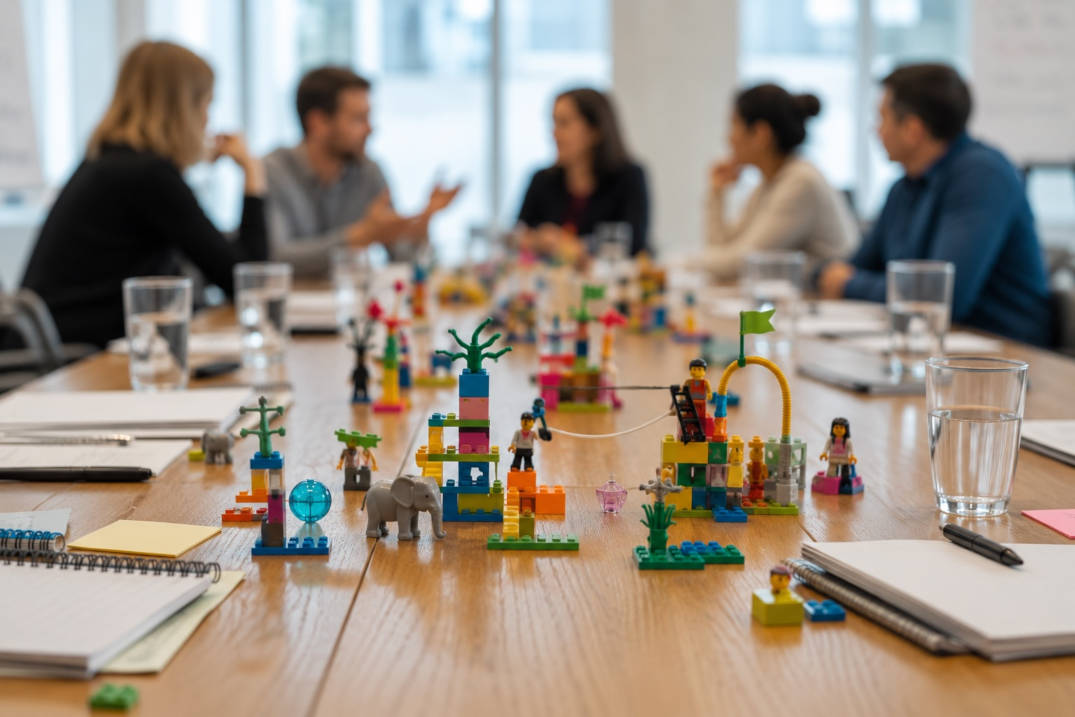
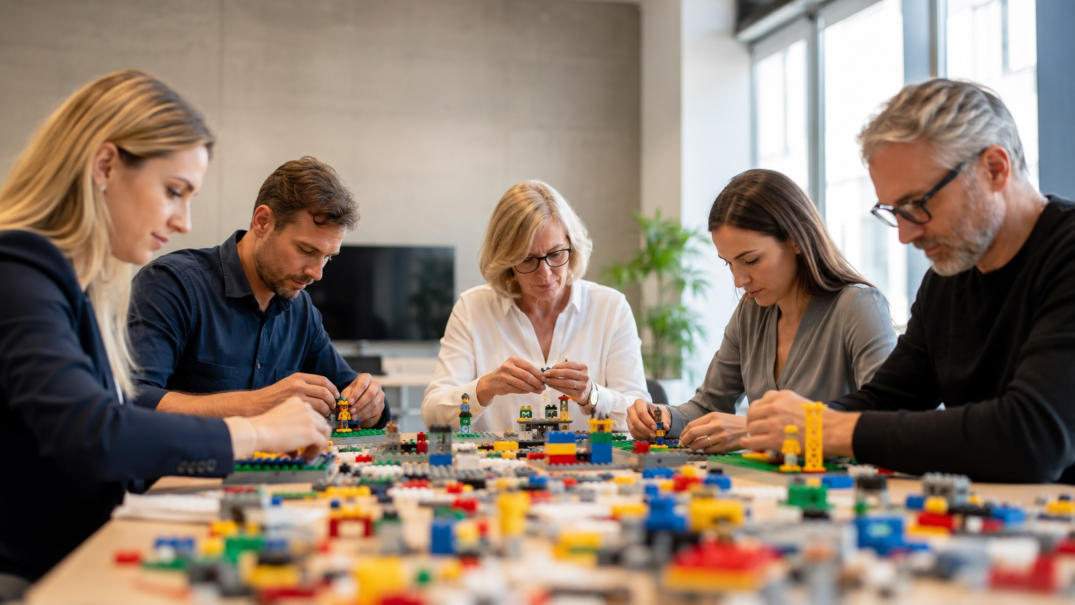
Seven colleagues first built individually how the department works today and how it is perceived from the outside. These individual models were then combined into a shared model that brought all perspectives together, not just the lowest common denominator.
What was the concrete outcome of the workshop?
A jointly supported clarification of roles and responsibilities that served as a reference throughout the further course of the change process. The head of the department herself describes the result as deeply impressive and would use the method again for other topics.
Is LEGO SERIOUS PLAY also suitable for non-business organisations?
Yes. This case comes from church administration, not from a company. The method works wherever people work together, regardless of whether it is a company, a public administration or another organisation.
A case study with anonymised figures and a smiling stock-photo person. This is exactly not that. (Okay, except for the image, that one is AI-generated.) This story has a real name, a real organisation and a change process that is still ongoing today. You can listen to the full conversation with Judith Weber in the Enten-Talk podcast.
The starting point: 1,080 parishes become 36
Judith Weber heads the Adult Pastoral Care Department, specifically the Marriage, Family and Diversity Unit, at the Archdiocesan Pastoral Office in Freiburg. The administrative area she is responsible for is roughly half the size of Baden-Württemberg. Under the heading "Church Development 2030", the diocese is currently undergoing one of the largest structural reforms in its history: The former 1,080 parishes have already become 280 pastoral units, and these will soon become 36 large parishes.
At department level, this means far more than a new line in an organisational chart. Responsibilities are changing, the diocesan level is moving from a steering role to a supporting role, and roles that were previously clear have to be renegotiated. It was precisely in this environment that Judith Weber's team ran a LEGO SERIOUS PLAY workshop. Not an excursion. Work on a question that could not be postponed: What is our understanding of ourselves as a department, and where do we stand in view of the changes ahead?
Scepticism first, workshop later
How Judith discovered the method
Before this workshop happened, Judith herself was the only person in the team who even knew the method. She first encountered it during a seminar day at the Baden-Württemberg Leadership Academy, where participants built around the topic of leadership. What convinced her there was not the idea itself, but how concrete it became: "This doing something, something actually emerges, really concrete, not just in your head", as she describes it in the conversation. By the end of the seminar day, she knew she wanted to find out how to get in touch with that trainer.
First scepticism, then trust
Within her own team, the initial reaction was different. "Judith, are You sure this is the right thing for us at this point?" was one of the first questions she had to listen to. Understandable: She was the only person with first-hand experience, while the rest of the team had to trust her word. Her answer was simple, but firm: Yes, I am absolutely sure, we will work out the answers together.
This sequence, first scepticism within the team, then conviction through the experience itself, is not an exception. I describe in more detail in Does LEGO® SERIOUS PLAY® really work? exactly how the Core Process behind it works and why the initial scepticism almost always disappears once people have their own bricks on the table.
What happened in the workshop
Three retreat days, one process
The workshop itself was embedded in a larger process: Three retreat days over the course of the year, one with the department's leadership team in January, one with the entire team in April, and one and a half days in August together with me. During one of the previous retreat days, the team had also worked with the Church Membership Survey, a scientific study on changes in church and society, in order to view their own work from an external perspective as well.
From seven individual models to one shared picture
During the LSP workshop itself, the seven members of the department conference first built individually how the work looks today and how the department is perceived from the outside. In the next step, these individual models were turned into a shared model. Not the lowest common denominator, which is rarely found anyway when seven people bring different perspectives. A shared view in which every single perspective genuinely had a place and in which the group negotiated how the individual parts fit together.
Judith describes the effect like this: It was not only about the method itself, but also about how people interact, about the idea that every person is heard and can express themselves. As head of department, she was additionally interested in how the heads of the individual units viewed collaboration within the department and where things had not yet been clarified.
The colleague who started building on her first working day
One detail from this workshop shows how seriously the team took the method in the end. A new employee had her very first working day in the department on exactly the day the workshop started. Judith had wondered beforehand whether she should take part at all, given that she did not know anyone on the team yet.
The decision was clear: She is part of the team, so she takes part. Looking back, Judith describes this as a real stroke of luck. The new colleague got to know the department and its leaders directly on her first day, fully embraced the method and built along with everyone else, and her perspective as an outsider who did not yet bring any preconceptions about the department was fascinating for everyone in the room. What does someone perceive when they come in from the outside? What is known, and what is not? Those are exactly the questions that would otherwise be almost impossible to answer.
The outcome, and what came afterwards
At the end, Judith draws a clear conclusion: "It worked incredibly well." When asked whether she would use the method again for other topics, her answer comes without hesitation: "Absolutely." What impressed her most was not only the concrete outcomes themselves, but also how much she learned about her own employees, who is willing to engage with an unfamiliar method, who enjoys building, and what that reveals about collaboration within the team.
When asked after the workshop what she hoped for in the near future, she named three things: That employees would go along with the change and find some enjoyment in it, that their work would continue to develop in a way that genuinely helps people in the new large parishes, and that the department would continue to use LEGO SERIOUS PLAY selectively because the method helps move things forward and brings a strong team-building effect.
What this means for Your own situation
No company, no sales team, no tech firm. A church administration department in the middle of one of the largest structural reforms in Germany, with real employees, real scepticism at the beginning and an outcome that the department head herself describes as deeply impressive. If the method works here, in an environment rarely associated with LEGO SERIOUS PLAY, that says more about its robustness than any glossy testimonial.
If You want to find out for Yourself what this feels like live: You can find dates for the next Meetups and training programmes at matthias-renner-trainer.com.
By Matthias Renner, AI-assisted research.

0 Comments