

A few quick answers up front:
What is the difference between constructivism and constructionism?
Constructivism according to Piaget describes how a person builds knowledge in their own mind through active interaction with the world. Constructionism according to Papert builds directly on this and adds one crucial point: Learning is particularly powerful when it produces a shared, tangible object, a sandcastle, a program or a LEGO® SERIOUS PLAY® model.
Who was Seymour Papert?
Born in Pretoria, South Africa, in 1928. A mathematician and learning researcher. He worked directly with Jean Piaget in Geneva for five years, until 1964, before moving to MIT, and in 1980 published "Mindstorms: Children, Computers, and Powerful Ideas", which laid the foundation for constructionism.
What does "Objects to Think With" mean?
An object to think with is a tangible thing that allows an abstract idea to become visible and changeable instead of merely being thought about. Papert used a programmed turtle that children controlled across a screen. The thinking happens through the object itself, not only in the mind in front of it.
What does this have to do with LEGO SERIOUS PLAY?
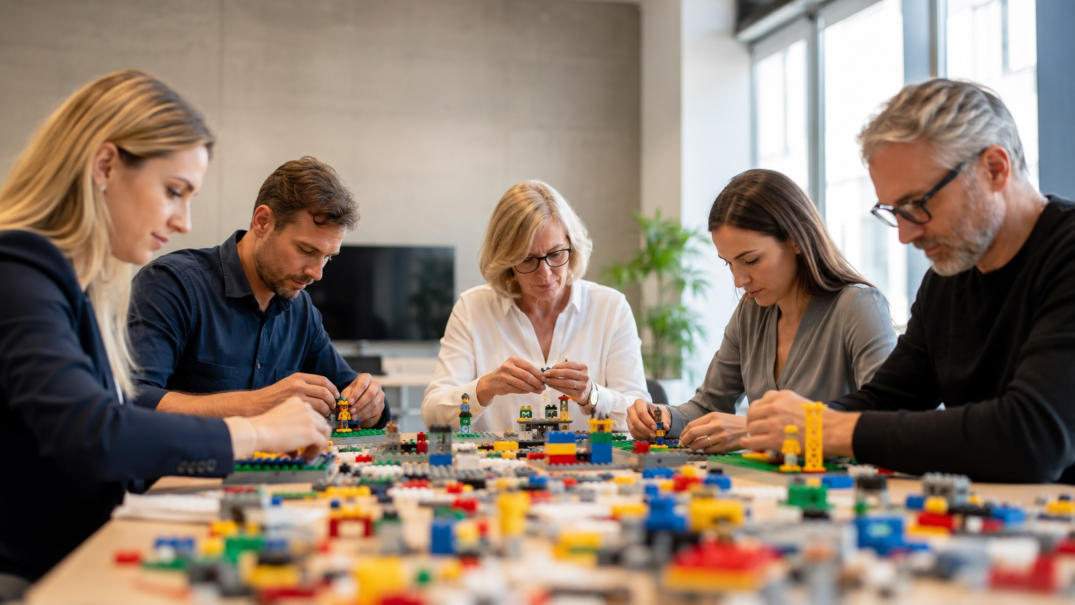
The model built in a workshop is exactly such an object to think with. It is not created to illustrate an already finished opinion. It helps generate the opinion during the building process itself, making it visible and shareable for the whole group.
According to the foreword of his book "Mindstorms", Seymour Papert knew the word gears before he was even two years old. He only understood how gears really worked years later, but from then on they became his favourite toys, especially the differential gear. Papert later wrote that this early love of gears could not be explained in purely cognitive terms. This childhood fascination became a key to abstract mathematics for him: Equations with two unknowns suddenly made sense because he could imagine them as interlocking gears.
Years later, while reading Piaget's work, Papert recognised in this memory what Piaget called "assimilation": fitting new experiences into existing patterns of thought. He nevertheless remained convinced that part of the story was missing. Piaget described assimilation almost exclusively as a cognitive process. For Papert, the gear was not merely an object of thought.
From this gap, between what Piaget described and what Papert himself had felt, grew one of the most influential learning theories of the 20th century: constructionism. Papert's own summary, decades later: What gears could not do for every child, perhaps the computer could. This idea required decades of research at MIT, culminated in a single book in 1980, and still explains why the model built in a LEGO SERIOUS PLAY workshop can achieve more than any presentation.
Where constructivism ends and constructionism begins
A development from within
The first article in this series introduced Jean Piaget's constructivism: Knowledge does not arise through listening. It emerges when a person actively interacts with the world and builds their own internal model from that experience.
This gap, the feeling alongside the understanding, never let Papert go. He worked directly with Piaget for five years, until 1964, at the International Centre for Genetic Epistemology in Geneva. Constructionism is therefore not a counter-theory intended to disprove Piaget. It is a deliberate development from within, formulated by someone who had sat at the table with the original thinker.
Papert in his own words
In his own words, Papert described the difference like this: Constructionism shares constructivism's basic assumption that knowledge is built through the progressive internalisation of actions. It adds one crucial point: This works particularly well when the learner is consciously engaged in building something public and shareable, whether that is a sandcastle on the beach or a theory of the universe.
Ackermann: inward versus outward
Cognitive scientist Edith Ackermann, who worked closely with Papert at MIT, summarised the difference in a widely cited paper: Piaget's perspective looks inward, towards the stable internal structure of knowledge. Papert's perspective looks outward, towards the dynamics of change, towards what emerges when thinking gains an expression outside the head. Ackermann compares Piaget's image of the learning child with a young Robinson Crusoe, alone and curious, exploring an uninhabited island. Papert's child, by contrast, remains in relationship, with people and with things, and learns precisely through this connectedness.
Objects to Think With
His own experience with gears could not simply be transferred to every child. A love of gears is perhaps rather unusual, and not every child falls in love with the same mechanics. So at MIT, Papert built something more universal: the LOGO programming language, which years later also gave LEGO Mindstorms its name, see No invention from the drawing board: The story of Rasmussen and Kristiansen. What emerged from this he called an "Object to Think With", an object for thinking. Children controlled a small digital turtle across the screen and made it draw geometric shapes. The aim was never to learn programming for its own sake. The turtle was a tool through which abstract mathematical ideas such as angles, repetition and symmetry suddenly became tangible and changeable. A child did not first have to understand what a right angle was in order to use one. They tried something, saw the result, corrected it, and in doing so understood what a right angle was.
Together with sociologist Sherry Turkle, Papert later went one step further. In their paper "Epistemological Pluralism and the Revaluation of the Concrete" (1991), they questioned a basic assumption of classical epistemology: that abstract, impersonal knowledge is automatically superior to concrete, personal knowledge. Their thesis: Concrete thinking, working with a tangible object, is not merely a preliminary stage on the way to proper abstract thinking. It is an independent and fully valid way of knowing that does not disappear in adults or even scientists once they become "grown up" in their thinking.
Why the model knows more than the mind that builds it
The inner editor is faster
This is one of the major differences between a "normal feedback round" and a LEGO SERIOUS PLAY workshop. When people are simply asked to state their opinion, they almost automatically fall back on what they had already thought or what they considered socially acceptable. The inner editor is faster than the honest thought. We more or less slap our own thoughts on the fingers.
When the hands decide before the head explains
Building works differently, explained in neuroscientific detail in Hands and mind: What Embodied Cognition knows about thinking with Your hands. While the hands work with shapes, colours and connections that nobody predetermined, decisions emerge for which the mind does not yet have a finished explanation. Only when telling the story of the finished model is the person who built it confronted with their own result and has to explain it to themselves. And that is precisely when surprising results emerge.
This aligns exactly with the four-step Core Process from LEGO® SERIOUS PLAY® explained briefly: Question, Build, Share, Reflect. In Papert's theory, the "Share" step is not a side issue, it is the moment in which the built knowledge truly comes into being. The model is not created to illustrate an idea that already existed. The building is the thinking process itself, not the packaging added afterwards.
A model You can touch
The second building block of Papert's theory concerns what happens to the finished object once it exists. Ackermann describes it like this: A built model takes on a life of its own and can from then on be treated as if it were "not me". Only then does a dialogue with it become possible, both the inner dialogue of the person who built it with themselves and the dialogue with everyone else around the table.
In a group, this creates an additional effect. Every model on the table is public, visible and tangible for everyone. Other participants can point to a specific brick and ask directly why exactly that brick is sitting there, something that would hardly be possible with a purely verbal statement. Piaget's constructivism describes well how an individual person arrives at an insight. Papert provides the explanation for why that insight suddenly becomes shareable in a room full of people without anyone having to put it into perfect words beforehand.
What this means for the role of the Facilitator
Trust in the building process
For aspiring Facilitators, constructionism shifts the perspective on what the actual task in the room is. It is not about explaining a topic well before the building begins, however tempting that may be for any well-prepared person. It is about giving the group enough trust in the building process itself, even when a model initially looks confusing, unfinished or surprising.
When silence does the real work
The greatest temptation for inexperienced Facilitators is to intervene too early, to explain, to structure, because silence at the table feels uncomfortable. But this silence is the moment in which the object is doing its actual work, closely related to what Flow Theory shows about the right level of difficulty during building. Anyone who interrupts it too early takes away the thinking process that building has only just made possible.
Constructivism explains why acting teaches better than listening. Constructionism explains what happens once that action becomes a shared, tangible thing. For LEGO SERIOUS PLAY, these are not two separate theories. They form one continuous line of reasoning that begins with the individual and ends with the group. How this line continues through further schools of thought, from neuroscience to Flow Theory, is shown in The science behind LEGO® SERIOUS PLAY®.
Anyone who would rather experience this themselves than only read about it can get a first, no-obligation impression of what an object to think with actually feels like at the next dates.
By Matthias Renner, AI-assisted research.

0 Comments