
A few quick answers up front:
What does "Playful Learning" mean?
Playful Learning refers to play-based learning that is deliberately used for serious content, not as a distraction from it. The term comes from English-language educational research and describes formats that use a clearly defined play framework to make topics accessible that are more difficult to address in ordinary conversation, for example in workshops using LEGO® SERIOUS PLAY®.
Is "play theory" here the same as the mathematical game theory of John von Neumann?
No, this is purely an overlap in terminology. Mathematical game theory goes back to John von Neumann and became widely known through John Nash, played by Russell Crowe in "A Beautiful Mind": It deals with strategic decision-making in conflict situations, negotiations and market models. The play theory meant here comes from cultural and social sciences, shaped by authors such as Huizinga, Mainemelis, Ronson, Henricks and Sicart, and examines play as an independent form of human behaviour, not as a mathematical model for conflict.
Do Huizinga and more recent play theorists such as Sicart contradict one another?
Partly, but not on a point that calls "serious play" into question. Huizinga emphasises order within a clearly bounded play space. Henricks adds that play contains both order and disorder at the same time. Sicart goes further and describes how play extends beyond its own space into the real world. For workshop practice, the crucial point is that a threshold exists at all, not how neatly theory describes it in every detail.
Does a fixed set of rules not contradict the freedom that Huizinga describes as a characteristic of play?
No. Huizinga's "freedom" refers to the fact that nobody can be forced to play, not to the absence of rules within the play itself. Fixed rules, such as a specific building time or predetermined bricks, are according to Mainemelis and Ronson even among the conditions that distinguish play from arbitrary behaviour.
Just before someone reaches for the bricks for the first time in a workshop, almost the same thing always happens: A brief hesitation. A glance to the side to see whether colleagues have already started. Sometimes a small, apologetic laugh before the hand even touches a brick, in behavioural research a classic displacement activity: an evasive movement that occurs when the impulse to act and uncertainty about whether that action is appropriate are active at the same time. What lies behind it is simply the question: Am I allowed to take this seriously even though it looks like play?
Play theory has been dealing with this question for almost a century, long before anyone thought of using it to design strategy workshops. The simple answer: The apparent contradiction between "serious" and "play" is not a contradiction at all. It is the actual mechanism. In the English-speaking world, the term Playful Learning has become established for this principle, play-based learning that is deliberately used for serious topics, not as their opposite.
But one thing at a time.
What play theory understands by play
Huizinga: Play as a space of its own
The Dutch historian Johan Huizinga attempted in his still widely cited 1938 work "Homo Ludens" to define play as an independent category of human behaviour, not as childish nonsense or a pastime, an almost audacious undertaking for a topic most people consider settled as soon as a child can walk, especially at that time. His observation: Play is free, nobody can be forced to play, otherwise it stops being play. Play consciously steps outside "ordinary" life and takes place in its own bounded space, in time and place. This is the part that matters for "serious play": "Within the play-ground an absolute and peculiar order reigns," Huizinga writes, an order that has no meaning outside this space.
A model is an "as if"
This bounded space is described in research as a kind of threshold, a state between two worlds. Organisational researchers Charalampos Mainemelis and Sarah Ronson summarised this precisely in a widely cited paper on play and creativity in organisations: When people play, they are in a threshold state between true and false, without either one fully applying. An example from childhood that they use for illustration can be transferred directly to a workshop table: In cops and robbers, the robber is not a real robber, but is also not not a robber. They act as if.
A built model is an "as if". If a model made of colourful LEGO bricks represents an uncomfortable truth, a taboo or whatever else for a team, it is not that truth itself, but it is also not simply nothing. It carries a real statement without requiring the person who built it to state that truth directly and unprotected into the room. With the help of an assembled pile of colourful bricks, it is possible to say things even to senior management that might earn someone a formal warning if written into the meeting minutes.
The debate that play theory itself has never settled
Henricks and Sicart challenge Huizinga
And is science united on this? Of course not, which makes it all the more interesting. Play theorist Thomas Henricks differentiates Huizinga's emphasis on order: According to his analysis, play contains order and disorder at the same time, not only the order emphasised by Huizinga. Anyone who has ever seen a finished model deliberately taken apart again at the end of a workshop round knows what I mean. Order is clearly not a prerequisite for entering play.
Media scholar Miguel Sicart goes even further in his book "Play Matters": According to his thesis, play does not remain neatly inside its own space at all. It constantly spills over into politics, vandalism and ordinary everyday life instead of obediently staying where Huizinga would have located it. Orderly or not, for functioning "serious play", it is ultimately enough that a threshold exists at all, not that it is maintained perfectly.
The debate about play and work
The second and more practically relevant debate concerns not play itself, but its counterpart: work. Since industrialisation, the separation between the two has almost been treated as a law of nature: play for children, poets and idlers, work for serious adults. As early as 1927, the Belgian social theorist Henri de Man argued against this, saying it was "psychologically impossible" to permanently deny employees the drive to play, even under the tightly controlled Taylorism of early industrial workplaces, a finding that organisational research still cites today. Corporate-wellness language for "people will secretly play anyway" therefore existed long before anyone put a table football game into an open-plan office. Almost a century later, organisational research shows how right he was: Play behaviour does not disappear when it is suppressed, it simply shifts into coffee breaks, corridor conversations and the minutes before the "real work". The question is not whether people play in a work context. They do. The much more interesting question is whether an organisation uses this deliberately or leaves it to chance.
Why the framework actually makes a difference
Five elements of play
For "serious play" to be more than an attractive phrase, the playful framework has to produce something measurable, not merely sound good. Mainemelis and Ronson addressed this question and broke play down into five elements that distinguish it from ordinary behaviour:
- Threshold experience. The feeling of being inside and outside ordinary reality at the same time, like the "as if" described above.
- Clear boundaries in time and space. A specific place, a specific duration, a clear ending.
- An interplay of uncertainty, freedom and constraint.
- A loose rather than rigid connection between means and ends.
- Positive emotional involvement.
The middle ground between freedom and structure
What does "an interplay of uncertainty, freedom and constraint" mean? In essence, it is more or less a description of a workshop. The rules are fixed: Certain bricks, a limited amount of time, a specific question. Within these fixed boundaries, however, the outcome is completely open. Nobody knows in advance what will end up on the table, not even the person who is currently building. (Something that can be observed again and again in LEGO SERIOUS PLAY.) According to the research, this combination of tight rules and an open outcome is what actually releases creativity: Too much freedom creates paralysis, too much structure creates repetition of what is already known. This middle ground, not either extreme, is the reason play can produce creativity at all, the same logic that lies behind Flow Theory: What helps people increase concentration and enter Flow is not a super-easy task. It is one that is just slightly too difficult.
Means, ends and emotion
The remaining two elements operate more quietly, but contribute just as much to the outcome. The loose connection between means and ends means that when someone builds, they rarely know at the beginning where their hands are going. A brick is placed because it fits in that moment, not because it was predetermined what it would represent in the end. This reversal, acting first and understanding afterwards instead of the other way around, produces insights during the building process that pure planning in the head could never have produced. The same effect is described by Embodied Cognition research, only at a neurological rather than workshop level. And positive emotional involvement, the fifth element, is not just a pleasant side effect. It is a prerequisite for the other four to work at all. Without it, the same structure becomes nothing more than some strange exercise with colourful bricks.
Less fear of evaluation
This also helps explain why the playful framework reduces the fear of evaluation that runs through every normal meeting. As soon as something is marked as play, a different logic of evaluation temporarily applies. An unusual, perhaps even absurd-looking idea that would immediately be dismissed as unprofessional in a regular meeting is allowed to emerge during the building process. Initially, it is not measured by whether it is realistic. It is only measured by whether it can be built. This shift is not a nicety, it is the real reason why things emerge in workshops that would never have been said in a normal meeting.
Back at the workshop table
The boundaries are meant literally
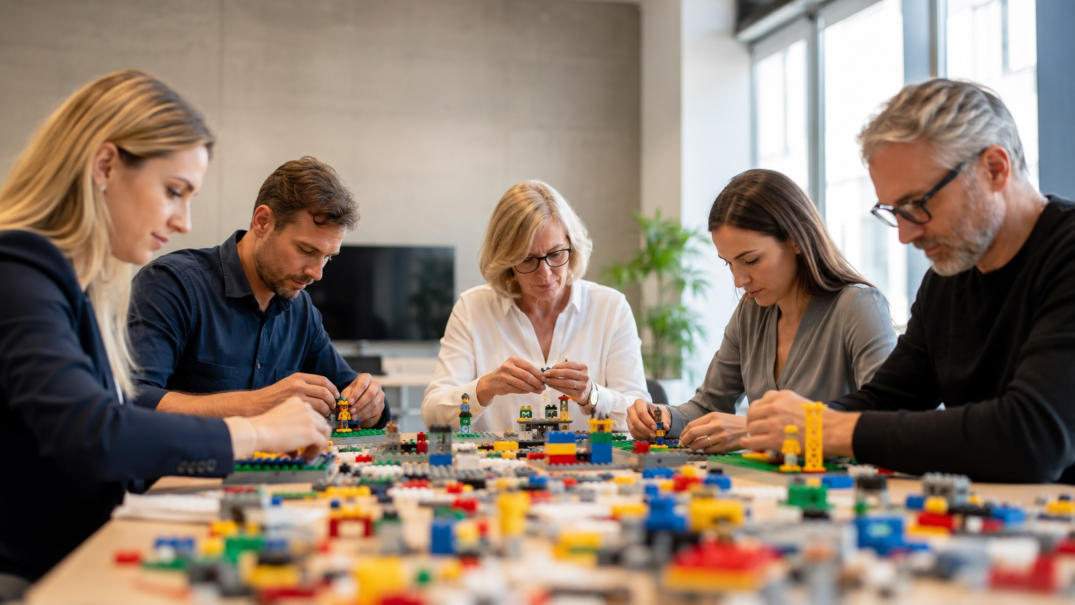
The framework of question, building time and fixed bricks is not attractive packaging around the real content. It is the condition that allows the content to emerge at all. The clear boundaries in time and space are meant literally in the workshop: a specific room, a limited period of time, a defined set of bricks. Within these boundaries, something can emerge that rarely happens outside them, because the threshold between "this is play now" and "this is real now" becomes permeable for a moment.
Why the model takes over the work
This also explains why the model does the actual work, not the person speaking. A provocative statement about one's own manager, expressed directly, is a risk to one's position in the room and possibly to the next performance review as well. The same statement, built from amusing LEGO bricks and told through the model, is a contribution to the play whose rules were established before it began. Anyone sitting at such a table for the first time usually feels this difference without being able to name it. Play theory provides the explanation afterwards for why exactly this framework works and why it cannot be replaced by a "relaxed conversation round", however good the intention may be. A relaxed conversation round lacks three things: a fixed threshold, clear rules, a binding "as if". Without them, the same effect does not occur.
For anyone considering facilitating the method themselves, there is also a practical consequence in this. Deliberately setting and holding the rules of the play is part of the actual Facilitator role, not just formulating the right question. A workshop whose framework remains unclear, where people sometimes build and sometimes simply discuss, loses exactly the threshold that makes the difference.
And that is also why these things need to be taught as part of the training.
Not a contradiction. A formula.
"Serious play" sounds like a compromise between two things that do not really belong together. Play theory shows the opposite: The two words describe the same mechanism from two different perspectives. The content negotiated in the model is serious. Play is the structure that makes exactly this content accessible in the first place because it reduces fear of evaluation without diluting the substance of the statement.
How Flow, Embodied Cognition and further scientific foundations combine to explain the method is collected in the overview article on the science behind LEGO SERIOUS PLAY. Anyone who does not yet know the method can start with LEGO® SERIOUS PLAY® explained briefly.
A threshold can be described. It is only crossed at the table. The next dates are available at matthias-renner-trainer.com.
By Matthias Renner, AI-assisted research.

0 Comments