
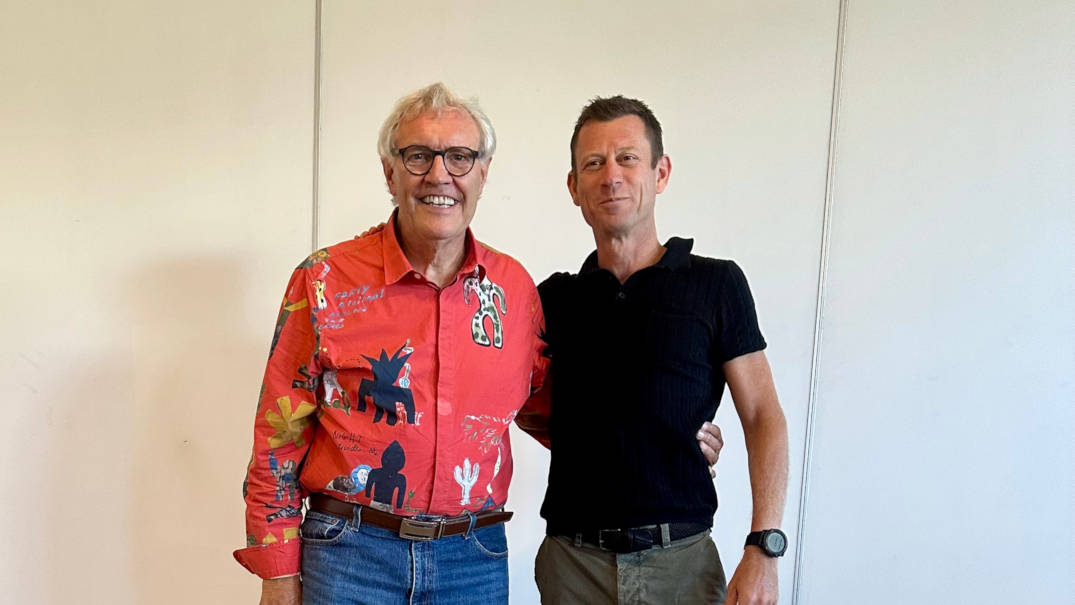
A few quick answers up front:
Who developed LEGO® SERIOUS PLAY® (LSP)?
Danish educator Robert Rasmussen led the development from 1999 onwards, and strategist Per Kristiansen joined at the end of 2001. In 2001, the completed method was presented to the public. The detailed timeline can be found in LEGO® SERIOUS PLAY® explained briefly; this article goes one step further: Who were the two professionally before they developed the method?
Did Johan Roos and Bart Victor develop LEGO SERIOUS PLAY?
No. In the mid-1990s, they had the original idea of using LEGO bricks for strategy work and experimented with it themselves for several years. But it only became a robust, repeatable method when Robert Rasmussen took over systematic development from 1999 onwards. The official origin story of the AoMT essentially says that with Roos and Victor alone, it had not yet "clicked".
What is Robert Rasmussen's academic background?
Rasmussen holds a Master's degree in Education from the Royal Danish School of Education in Copenhagen and also studied psychology and sociology. He spent a total of 13 years (1988–2001) at LEGO as Head of Research and Development for LEGO Education, where he was responsible, among other things, for LEGO Mindstorms. The first eleven of those years came before 1999, the year in which he additionally took over the development of LSP.
What is Per Kristiansen's professional background?
Kristiansen holds a Master's degree in International Business (intercultural management) from Copenhagen Business School, complemented by examinations at Università Bocconi in Milan. At LEGO, he later headed the global LEGO SERIOUS PLAY business before moving to Trivium in 2006.
What does LEGO SERIOUS PLAY have to do with LEGO Mindstorms?
Both products emerged from the same LEGO division under Rasmussen's leadership. Mindstorms is named after the book by MIT researcher Seymour Papert, whose colleagues at the MIT Media Lab and Tufts University Rasmussen collaborated with throughout his time at LEGO Education.
Two names appear in every explanation of LEGO SERIOUS PLAY: Robert Rasmussen and Per Kristiansen. The rough chronology can be summarised quickly: The idea came from Johan Roos and Bart Victor in the mid-1990s. The method was developed by a team around Rasmussen, Kristiansen joined later, and together they founded the Association of Master Trainers (AoMT) in 2010. This timeline is already described in detail in LEGO® SERIOUS PLAY® explained briefly, so we will not repeat it here.
What is missing from that timeline is the professional background of the two men themselves. That explains more about why the method still holds up today than any founding year ever could.
Robert Rasmussen: The educator behind LEGO Mindstorms
Eleven years at LEGO Education
Before Rasmussen took over the development in 1999, he had already spent eleven years as Head of Research and Development for LEGO Education. His academic background is a Master's degree in Education from the Royal Danish School of Education in Copenhagen, along with studies in psychology and sociology.
Why Mindstorms is named after Papert
In this role, he was responsible, among other things, for the educational concept behind LEGO Mindstorms, still the best-selling product in LEGO company history. The name is no coincidence. Mindstorms is named after the 1980 book "Mindstorms: Children, Computers, and Powerful Ideas" by Seymour Papert. Papert is regarded as the founder of constructionism, more on this in From constructivism to constructionism. Papert had worked directly with Jean Piaget in Geneva, whose constructivism we have already covered, before moving to MIT, where in 1985 he became one of the founding members of the MIT Media Lab, MIT's interdisciplinary research institution for technology and learning. There he headed the "Epistemology and Learning" research group, the intellectual home of constructionism.
How the contact with MIT began
The connection between LEGO and Papert was established personally in 1984 by then LEGO CEO Kjeld Kirk Kristiansen, grandson of the company's founder. Apparently, a television interview with Papert was enough for him to seek direct contact with MIT himself. Kjeld and Per are not related. The surname is about as common in Denmark as Müller, Meier or Schulze in Germany. From then on, LEGO supported the Media Lab, and from 1989 even funded a professorship created specifically for Papert.
What emerged concretely from this collaboration can be read about rather than merely claimed: As early as 1987, more than a decade before the official market launch of Mindstorms, the Media Lab built an initial research prototype of the programmable LEGO brick. Chris Rogers from Tufts University developed ROBOLAB, the software used to program the first Mindstorms sets. In between came joint projects such as TC Logo and Control Lab, in which children built their own machines from LEGO bricks and programmed them at the same time, years before Mindstorms officially came onto the market in 1998.
A decade of preparation
Rasmussen was deeply embedded in this environment. Throughout his time as head of the Mindstorms development team, he worked directly with designers and researchers from Tufts University and the MIT Media Lab to develop action-based learning tools. He was the person on the LEGO side who ensured that Papert's learning theory actually became a product. Millions of children held it in their hands long before anyone thought about workshops with adults.
When Rasmussen additionally took over the development of what would later become LEGO SERIOUS PLAY from 1999 onwards, he brought with him a strong background in learning psychology: more than a decade of practical experience translating constructionist theory into a functioning product, within the very research environment that had produced the theory in the first place.
Per Kristiansen: The strategist who never stopped learning
From Change Agent to global business leader
Kristiansen came from a different direction. His Master's degree in International Business (intercultural management) came from Copenhagen Business School, complemented by examinations at Università Bocconi in Milan. At LEGO, he started as a Change Agent in the preschool division, acting as the right-hand person to the global Brand Director. At the end of 2001, he moved to Executive Discovery, a company founded and financed by Kjeld Kirk Kristiansen that initially developed and marketed LEGO SERIOUS PLAY independently alongside the actual LEGO Company. There, he was responsible, among other things, for the business in Europe, South Africa and the Middle East, and together with Rasmussen he was one of two global Master Trainers. When Executive Discovery was integrated into the LEGO Company, he took over global leadership of LEGO SERIOUS PLAY. A short period at Danfoss Universe followed, an innovation park that itself used LSP, before he became a partner at Trivium in 2006.
Six training programmes with some of the best-known names
What came afterwards is actually the more interesting part. Kristiansen did not stop learning after the development of LSP. Over the years, he deliberately trained with some of the most recognised names in change and complexity management:
- "Leading Change and Organizational Renewal" at Harvard Business School.
- "Leadership Foundations" with Peter Senge (MIT), the pioneer of systems thinking in organisations.
- "Presencing: Collective Leadership for Profound Innovation and Change" with Otto Scharmer (MIT), known for his Theory U.
- Accreditation as a Cognitive Edge Facilitator, the framework for complex decision-making situations developed by Dave Snowden.
- Training in "Transformative Scenario Planning" with Adam Kahane and Reos Partners. In the early 1990s, Kahane facilitated the Mont Fleur Scenarios, a process that contributed to the peaceful negotiation of South Africa's transition out of apartheid.
- Membership in the NeuroLeadership Institute, including a certificate in the fundamentals of NeuroLeadership.
Together with Rasmussen, Kristiansen later also published "Building a Better Business Using the LEGO SERIOUS PLAY Method" (Wiley, 2014), the first book the two wrote about the method.
Two completely different paths, one shared table
Two perspectives that complement each other
An educator and a strategist at the same table: That could have gone completely wrong. What these two biographies show instead is this: Two perspectives that complement each other rather than getting in each other's way. Rasmussen brought the educational perspective, rooted in the very research environment that produced constructivism and constructionism. Kristiansen brought the business perspective, and over decades he continued to develop it with some of the most serious voices in change and complexity.
Senge, Scharmer, Snowden and Kahane are not peripheral figures. They are among the best-known names in systems thinking, complexity and change.
Six years of development, not a weekend project
For aspiring Facilitators, this means: This method is not simply the result of a weekend with colourful LEGO bricks and a good idea. From the original idea in the mid-1990s to the completed method in 2001, more than six years passed in which people from completely different professional worlds worked on it.
For Rasmussen, the story did not end there, by the way: What he later developed further as LEGO SERIOUS PLAY 2.0 is now the standard taught by the Association of Master Trainers, but that is an article of its own.
How these two biographies fit into the wider science behind the method is shown in the overview The science behind LEGO® SERIOUS PLAY®.
Anyone who wants to experience for themselves how this combination of education and strategy actually works in a workshop instead of only reading about it can get a first, no-obligation impression at the next dates.
By Matthias Renner, AI-assisted research.


0 Comments