
A few quick answers up front:
Is LEGO SERIOUS PLAY (LSP) scientifically grounded, or just a nice creativity method?
The method is based on constructivism, constructionism, neuroscience, flow theory and play theory. In use since 2001, with more than two decades of practical experience, not something invented last quarter.
Who developed the method?
The original idea came from Johan Roos and Bart Victor in the mid-1990s. It was developed by a team around Robert Rasmussen, with Per Kristiansen joining later. Together, they founded the Association of Master Trainers (AoMT) in 2010, which continues to teach the method in its original depth to this day.
What distinguishes LSP from a normal workshop discussion?
In most meetings, a small proportion of the people present do the talking, while the rest listen, nod and save their real opinions for the coffee break afterwards. With LSP, every person builds, tells their story and is heard. That means every perspective genuinely gets onto the table, not just those of the loudest voices.
How can I find out whether the method suits me without immediately committing to the four-day training?
The free Meetup gives You a first impression without having to commit straight away.
What do You actually take away from the training?
In addition to understanding the method, You receive a ready-to-use blueprint for a strategy workshop and a team workshop, ready to go instead of grey theory.
"Adults playing with LEGO bricks." That is usually the first sentence people say when they hear about LEGO SERIOUS PLAY for the first time. Often with a slight smile that already contains the answer: Nice, but ultimately just playing around.
"Easy enough for a child, but not child's play." That is one way to sum up the method in a single sentence, and that sentence carries more meaning than it seems to at first glance.
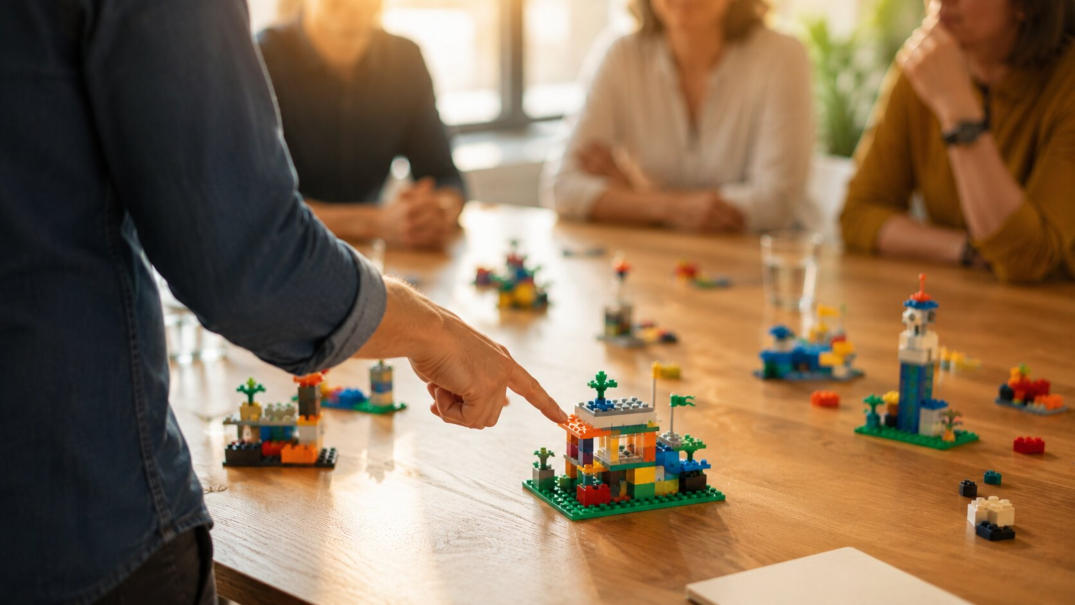
What happens in a workshop is quickly explained. The method is based on the Core Process, which repeats in every workshop, regardless of how big the question is, always in the same four steps:
- Question. The Facilitator asks a complex question.
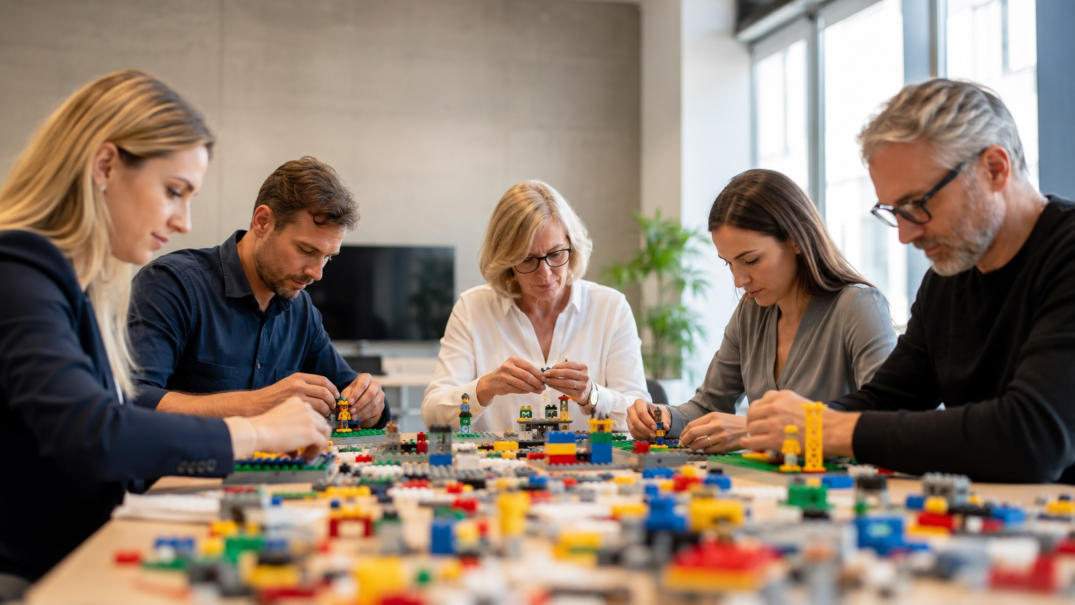
- Build. Each person uses special LEGO sets to build their own answer model. Each model represents its own perspective, an opinion, a position, an answer that might otherwise have been lost in the meeting.
- Share. The person who built the model explains what it means.
- Reflect. The stories inevitably lead to reflection, creating new insights that no individual had beforehand.
What happens in the process repeatedly surprises participants: People say things about their own perspective that surprise even themselves. "I didn't know that I knew that."
In English, there is a fitting phrase for it: "give your brain a hand": Your hands think along before your head catches up.
Put casually, You could almost say that this already explains the method. Of course, it does not, because there is much more to it.
Version 2.0 can do more than the Core Process alone suggests
LEGO SERIOUS PLAY in version 2.0 consists of three elements, not just the Core Process: the Core Process itself, seven Application Techniques that can be combined differently depending on the question, and Skills Building, which is where every workshop begins in the first place. Without this Skills Building, the group lacks the practice of thinking with their hands before moving on to the actual question. What the seven techniques do individually and how they combine into a workshop design deserves an article of its own.
Why this achieves more than a normal discussion
We all know how most meetings work. There is this unspoken rule: Whoever speaks the loudest or the longest determines the outcome. Around 20 percent of those present say what they always say, and with that, a large part of the knowledge in the room goes unused, an estimated 80 percent. Simply because nobody asked for it. Those who do not speak listen, more or often less attentively, nod (or deal with emails or their smartphone), and save their actual opinion for the coffee break. We like to call this a Lean-Back Workshop: Everyone leans back, a few people talk, and most of the knowledge in the room remains unused.
LEGO SERIOUS PLAY turns that into a Lean-Forward Workshop: Every person builds their own model, explains it, is heard and understood. That means every single perspective gets onto the table, brought together into a solution to which everyone has genuinely contributed. 100% task level, 0% relationship level: It is always about the model, never about the person who built it.
The core beliefs You rely on as a Facilitator
Every method has an underlying mindset. With LEGO SERIOUS PLAY, there are essentially five core beliefs, and as a Facilitator You carry these with You, not just the technique: People need to have a voice, to be heard and understood. They naturally want to contribute, to be part of something bigger and to take responsibility. Leaders do not have all the answers, even if business cards rarely say so. And sustainable success depends on all voices in the room genuinely being heard, not just the usual suspects.
Sounds like common sense. Yet hardly any meeting actually follows it, because the knowledge of individual members usually remains unused. As a Facilitator, Your task is to create a space in which these core beliefs can actually take effect.
What this means for You as a Facilitator
Not connecting bricks, but designing spaces
If You are considering learning the method Yourself: This is the skill that ultimately matters. It is not about connecting bricks correctly, most children can manage that within an afternoon after a certain age. It is about designing a space in such a way that nobody simply sits there listening in silence and every person genuinely contributes something.
What the four days actually give You
Four days of training give You exactly that: You learn how to design Your own workshops depending on the question, or more precisely, the question behind the question. It is not about treating symptoms. It is about getting to the root causes. Why that really requires four full days rather than one, two or three is explained in A short LEGO SERIOUS PLAY training is perfectly sufficient.
During the training, You will:
- Gain an in-depth understanding of the LEGO SERIOUS PLAY method in its current version 2.0, experience it and apply it.
- Learn how to combine and use the Core Process, the seven Application Techniques and Skills Building effectively.
- Receive a complete, ready-to-use blueprint for a strategy workshop and a team workshop, ready to go instead of grey theory.
- Learn how to manage dynamics and challenges in workshops, when a participant absolutely refuses to build or when a model suddenly reveals more than intended.
- Understand the scientific background that makes the method so effective, for those moments when someone asks whether these are not simply interlocking bricks.
- Internalise the rules, mindset and fundamental beliefs of the method so thoroughly that they naturally accompany every workshop without You having to consciously think about them.
The difference becomes apparent later, as soon as a workshop does not go according to plan, and sooner or later that is guaranteed to happen. Whether this ultimately turns into paid assignments depends on something the training alone cannot provide: What You really sell as a Facilitator.
What You can use it for later
A small selection, because the list is almost endless:
- Strategy development in which it is not only senior management that speaks.
- Team dynamics in which conflicts come onto the table before they continue simmering beneath the surface.
- Transformation processes in which uncertainty becomes something that can be worked on instead of something that is kept quiet.
- Innovation sessions in which the quietest person in the room contributes the decisive idea.
- Change processes in which resistance becomes visible before it paralyses the entire process.
- Coaching in which a person's own position often becomes clearer in the model than through conversation alone.
What You later do with LEGO SERIOUS PLAY is up to You. The method adapts to the topic, not the other way around. Only the building time remains roughly the same, whether the topic is team culture or the next acquisition.
The short version of the science behind it
Where the method comes from
LEGO SERIOUS PLAY was not invented at a drawing board. The method is based on constructivism, constructionism, neuroscience, flow theory and play theory, all of which help explain why hands and mind together bring more to the surface than the mind alone. It was developed by a team around Robert Rasmussen, following the original idea of Johan Roos and Bart Victor, together with Per Kristiansen, who joined later. Rasmussen and Kristiansen went on to found the Association of Master Trainers in the LEGO SERIOUS PLAY Method (AoMT) in 2010, which continues to teach the method in its original depth to this day. The idea emerged in the mid-1990s, and the completed method was presented to the world in 2001, which means it has now been in use for more than two decades, rather than having been invented last quarter.
The deeper background deserves its own article
Exactly how much lies behind constructivism, constructionism and flow theory deserves an article of its own, covering the scientific depth behind why LSP actually works instead of merely claiming that it does.
Spoiler alert: It is research, not gut feeling, even if it may feel different at first with colourful bricks in Your hands.
If You prefer to read about this from a corporate perspective, Brickolution® has a detailed page about the method.
What remains
"No buzzwords, but skills that last." That is the standard. This is not about adding another workshop format to the drawer. It is about having a tool that holds up when a group gets stuck and no presentation in the world can move things forward.
Whether this becomes a tool for You or remains a nice anecdote for the next coffee break is not decided by reading about it. It is decided the first time You stand in a room Yourself where suddenly everyone has something to say. It suits You. Or not yet. Or perhaps You are already the sceptic sitting right at the back who builds anyway.
The free Meetup gives You exactly that first impression without having to commit to four days straight away. You can find dates for the next training programmes at matthias-renner-trainer.com.
By Matthias Renner, AI-assisted research.

0 Comments