
A few quick answers up front:
What is Flow Theory according to Csíkszentmihályi?
A psychological model developed by Mihály Csíkszentmihályi that describes the conditions under which people become completely absorbed in an activity, focused, without a sense of time and without self-doubt. A central requirement is the balance between the challenge of a task and one's own abilities.
What does the balance between challenge and ability mean in practice?
If a task is too easy, boredom arises. If it is too difficult, anxiety or overwhelm arises. Flow only occurs within a narrow corridor in between, where the task lies just above the person's current level of ability.
Why do Facilitators limit building time in a LEGO SERIOUS PLAY workshop?
A fixed, usually short building time deliberately creates time pressure. This prevents prolonged deliberation and perfectionism and forces the hands to work spontaneously. This time pressure keeps the challenge within the right range, neither too easy nor paralysingly difficult.
Is every participant guaranteed to reach a Flow state in every workshop?
No. Flow is an empirically described psychological state, not a switch that workshop design can reliably turn on. What can be said seriously is this: LEGO SERIOUS PLAY fulfils several of the conditions that research describes as necessary for Flow, a clear task, direct feedback, an appropriate level of difficulty. That increases the probability, but guarantees nothing.
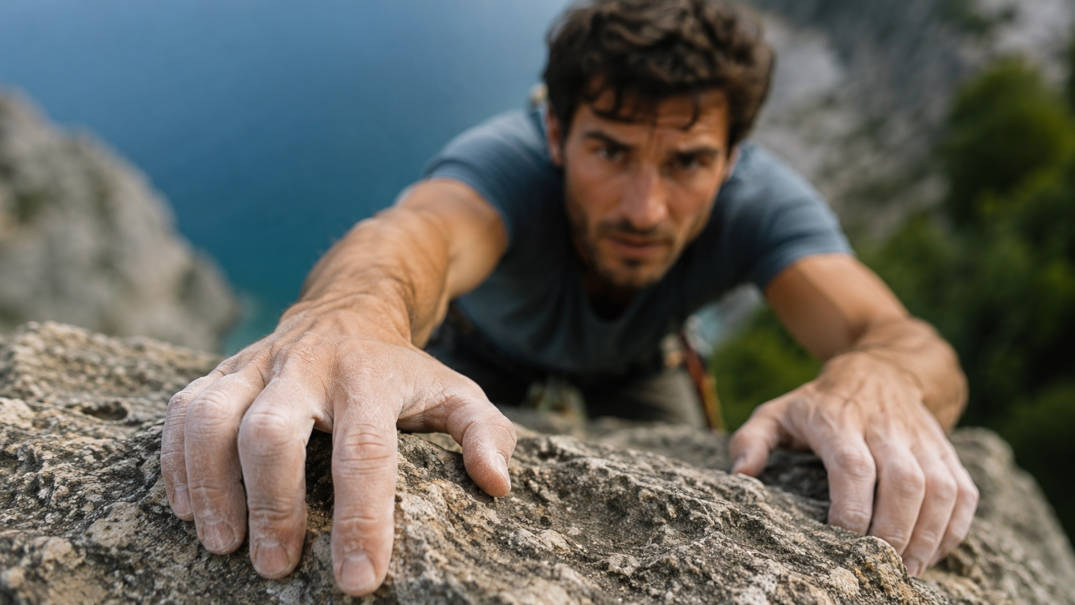
People voluntarily hang from a rock face, far above the ground, with no prize money and no audience even noticing their success. Why do they put themselves through this when it is exhausting and risky and promises no external reward? This question occupied a young psychologist in the 1970s. His answer began with interviews with climbers, chess players, dancers and surgeons, a remarkably odd focus group for a foundational work of psychology, and yet it led to one of the most influential concepts in modern psychology.
Who was Mihály Csíkszentmihályi and what did he study?
Four unusual groups of participants
Mihály Csíkszentmihályi, a Hungarian-American psychologist, published his foundational work "Beyond Boredom and Anxiety" in 1975. In it, he and a team of doctoral students examined four very different activities: chess, rock climbing, free dancing to rock music and surgery. The selection was deliberately provocative. All four activities require time, energy and sometimes personal safety, without any external incentive such as money or fame necessarily justifying them. Anyone who nevertheless spends hours doing them is apparently doing so because of the activity itself.
Where the name "Flow" came from
The name itself emerged from the interviews. "We called this the Flow experience", Csíkszentmihályi later wrote, "because so many of the people describing it used the image of a current carrying them along effortlessly." The metaphor came from the participants themselves, not from a laboratory.
From an overlooked book to an established term
The book initially received little attention. It was only with his second major work, "Flow: The Psychology of Optimal Experience" (1990), that the term became widely established, and it is now a recognised technical term in dozens of languages. A methodological innovation was crucial to its scientific reputation: the Experience Sampling Method. Instead of asking people afterwards how they had felt, which is distorted by memory, participants carried a pager that beeped randomly throughout the day over several days. Each time, they immediately recorded what they were doing and how they felt at that moment. This approach was what first made Flow something that could be systematically compared across thousands of everyday moments, rather than only in interviews with exceptional athletes.
The building blocks of a Flow experience
Csíkszentmihályi and later researchers such as Jeanne Nakamura broke the experience of Flow down into several characteristics. Three of these are considered prerequisites that need to be present before Flow can arise at all:
- A clear goal for the specific action, not merely a vague intention.
- Immediate, direct feedback on whether the action is working or not.
- A balance between the challenge of the task and one's own abilities.
When these three prerequisites are met, research describes a characteristic cluster of experiences: complete concentration on the task, a merging of action and awareness in which there is no longer any need to consciously think about what one is doing, and a sense of control over the situation. Added to this are the disappearance of self-doubt and self-observation, an altered sense of time in which hours can feel like minutes, and an autotelic experience in which the activity itself becomes the reward, regardless of any result that comes afterwards.
The right amount of resistance: The balance between challenge and ability
Of all the conditions mentioned, one is the most important in practice, and it gives this article its title. Csíkszentmihályi imagined challenge and ability as two axes in a diagram. Plotting one against the other produces a narrow diagonal zone, the so-called Flow Channel. If the task lies above this diagonal, the challenge exceeds the person's ability, resulting in anxiety or overwhelm. If it lies below, the task is too easy for the person's existing ability, resulting in boredom or apathy. Flow arises exclusively within this narrow band in between, where the task lies just above the person's current ability.
This explains why neither a building task at children's birthday-party level nor an unsolvable puzzle task leads adult participants into genuine immersion. Both fall outside the channel, one because it is too easy, the other because it is too difficult. It only becomes interesting when there is genuine resistance, when the task demands something without overwhelming. The first article in this series already showed that Jean Piaget's constructivism is based on this principle: Understanding emerges through acting against resistance, against something that does not immediately fit. Csíkszentmihályi's model provides the complementary perspective by describing exactly how much resistance is needed for concentration rather than frustration to emerge.
Two levers in a real workshop
Clear goal, direct feedback
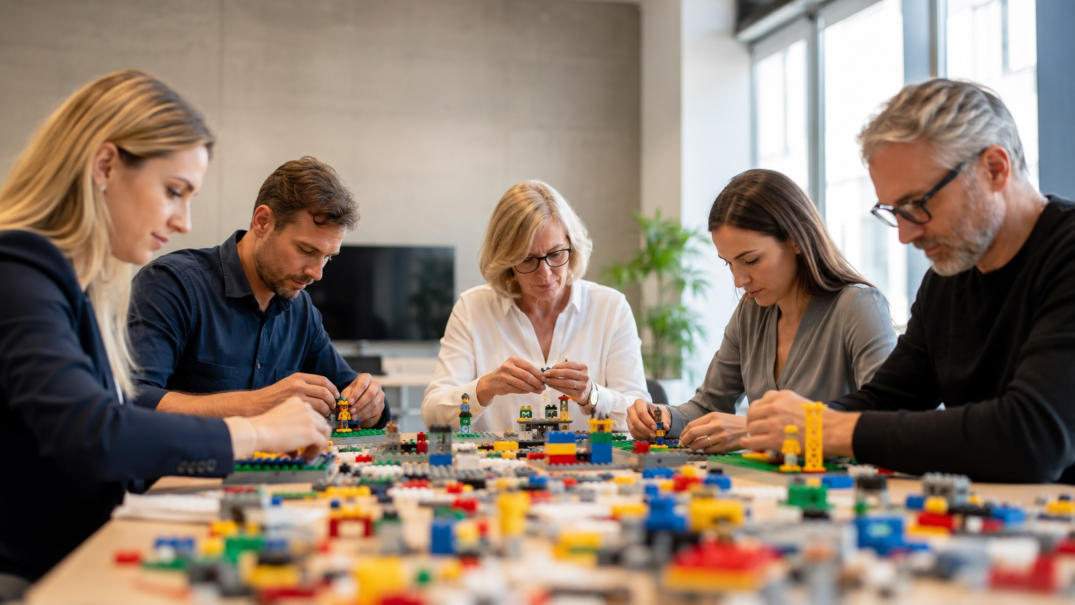
A workshop using LEGO SERIOUS PLAY, referred to below simply as LSP, fulfils several of these conditions without participants needing to know the underlying model. Every building task begins with a specific, clearly formulated question, never with a vague "build something". That provides the clear goal Flow requires. The immediate feedback comes from the emerging model itself: Does the shape that has been built fit what was meant, or does something still need to be added before the story can be told? Nobody has to wait for an external assessment; the model on the table immediately shows where something is still missing, the same object for thinking described in the article on Papert's constructionism.
Skills Building and fixed building time: the balance itself
The most revealing part, however, is the third condition, the balance itself, because it is deliberately controlled in two directions. On the ability side is the Skills Building phase, which is how every LSP workshop begins. In a short period of time, participants practise simple building tasks until their hands once again know how to work with the bricks. This noticeably raises their own level of ability before the actual, more demanding content questions begin. On the challenge side is the fixed building time, usually only a few minutes per round. This deliberately imposed time pressure is not a motivational trick. It prevents prolonged deliberation and perfectionism and pushes participants into spontaneous, non-analytical building in which the hands work before the inner critic can intervene, the same hand-mind coupling that the article on Embodied Cognition describes from a neuroscientific perspective.
Lean-Forward instead of Lean-Back
Together, these two elements keep the task within the narrow Flow Channel. Enough ability through the warm-up, enough challenge through the time limit and through the use of complex questions. This active, engaged state is called Lean-Forward in facilitation, the body leaning forward instead of the leaning back that signals how participants mentally check out in ordinary meetings, Lean-Back in the literal sense: no longer really present, even though the body is still sitting at the table. The building itself already prevents people from switching off, the hands are occupied and the mind stays in the room. How divergent and convergent thinking interact in this state will be explored in a later article in this series on Guilford's model of creativity.
When the calibration fails
What happens when the calibration between ability and challenge fails can be observed live in any workshop:
- A question that is too general and open to almost any interpretation, such as "Build a model of Your company", creates more of a children's-play atmosphere than genuine immersion, because hardly any resistance remains for people to engage with.
- A question that is too abstract and overloaded, such as "Build the entire future of Your industry", can produce the opposite effect, a brief moment of paralysis in which nobody knows where to begin.
You learn this distinction in a complete training programme.
From knowledge to experience
Real expertise only develops over many workshops. A well-facilitated LSP workshop exists as a complete sequence of questions before the first brick is ever picked up. Every question is carefully prepared in advance to fit the group and the topic. A workshop using the LEGO SERIOUS PLAY method has nothing to do with improvisational theatre with bricks during the process. This care in the design, combined with very good training, as opposed to a superficial short version, is what ultimately makes the difference to the outcome of the workshop.
Where the analogy reaches its limits
Methodological criticism of Flow research
Flow is a construct that is measured predominantly through self-reporting, either through interviews or Experience Sampling. Critical voices in the research have pointed out for years that this makes Flow difficult to measure objectively and means it cannot always be clearly distinguished in practice from simple interest or engagement. The order of causality is also not fully resolved: Does the right level of challenge create Flow, or do people who are already deeply engaged for other reasons simply report afterwards that the level of challenge felt appropriate? The two are difficult to separate in the data.
What the LSP studies actually show
For an LSP workshop, this means something very concrete: There are now direct studies, not merely analogies. As early as 2018, a study by Dirk Primus and Stephan Sonnenburg in the "Creativity Research Journal" showed that the LSP Skills Building phase, used as a creative warm-up exercise, had a positive effect on two of three measured Flow elements. A more detailed study followed in 2021, again with Sonnenburg as a co-author: Lukas Zenk and Stephan Sonnenburg compared LSP workshops with traditional meetings in the "European Journal of Innovation Management", using the same method mentioned above, Experience Sampling, with 39 participants from six teams. The result is more nuanced than a pure success story might suggest. On two individual Flow characteristics, satisfaction and autotelic behaviour, the visible counterpart to the autotelic experience described above, LSP performed significantly better than the traditional meeting. On one group characteristic, continuous communication, LSP performed worse, which can plausibly be explained by the fixed building and sharing rounds in which not everyone is allowed to talk at the same time. The creative output of the LSP teams was nevertheless higher in the end than that of the meeting teams.
A Danish side note: Hans Henrik Knoop
Notably, one of the better-known Flow researchers also happens to be based in Denmark, the home of LEGO. Hans Henrik Knoop teaches at Aarhus University, where he researches Positive Psychology, the branch of research established as a distinct field since the late 1990s that examines well-being, strengths and flourishing, and between 1998 and 2004 he worked on development projects for LEGO, during exactly the years when LEGO SERIOUS PLAY was also being developed. He shares more with Csíkszentmihályi than just the same research field: Both were part of the GoodWork Project by Howard Gardner, Csíkszentmihályi and William Damon, and both contributed a chapter to the resulting edited volume "Responsibility at Work", Csíkszentmihályi together with Jeanne Nakamura on creativity, Knoop on leadership from a Danish perspective. His input genuinely contributed to the development of LEGO SERIOUS PLAY, although this is barely documented externally; it belongs to the experiential knowledge of the method itself rather than its published literature.
Anyone who wants to explore Flow as a concept in its own right, independently of LSP, can find further material from other practitioners who connect Flow and LSP, for example at ThinkZoe.
Conclusion
The question of why people voluntarily hang from a rock face led to a model that reaches far beyond climbing: Concentration does not arise from making things as effortless as possible, it arises from exactly the right amount of resistance, neither too much nor too little. A LEGO SERIOUS PLAY workshop deliberately manages this resistance through a short warm-up phase that raises ability and through a tight building time that keeps the challenge high. What emerges is rarely simple boredom and even more rarely paralysing overwhelm. It is the narrow strip in between where serious work takes place and where surprising results repeatedly emerge.
Continue reading this article as part of the overall overview "The science behind LEGO® SERIOUS PLAY®", together with all the other schools of thought that help explain the method.
You can finish reading about it here. Feeling it only happens with Your own model, at one of the next dates.
By Matthias Renner, AI-assisted research.

0 Comments